Ecommerce Web Design Dubai: What to Know Before You Build (2026)

ecommerce web design in dubai

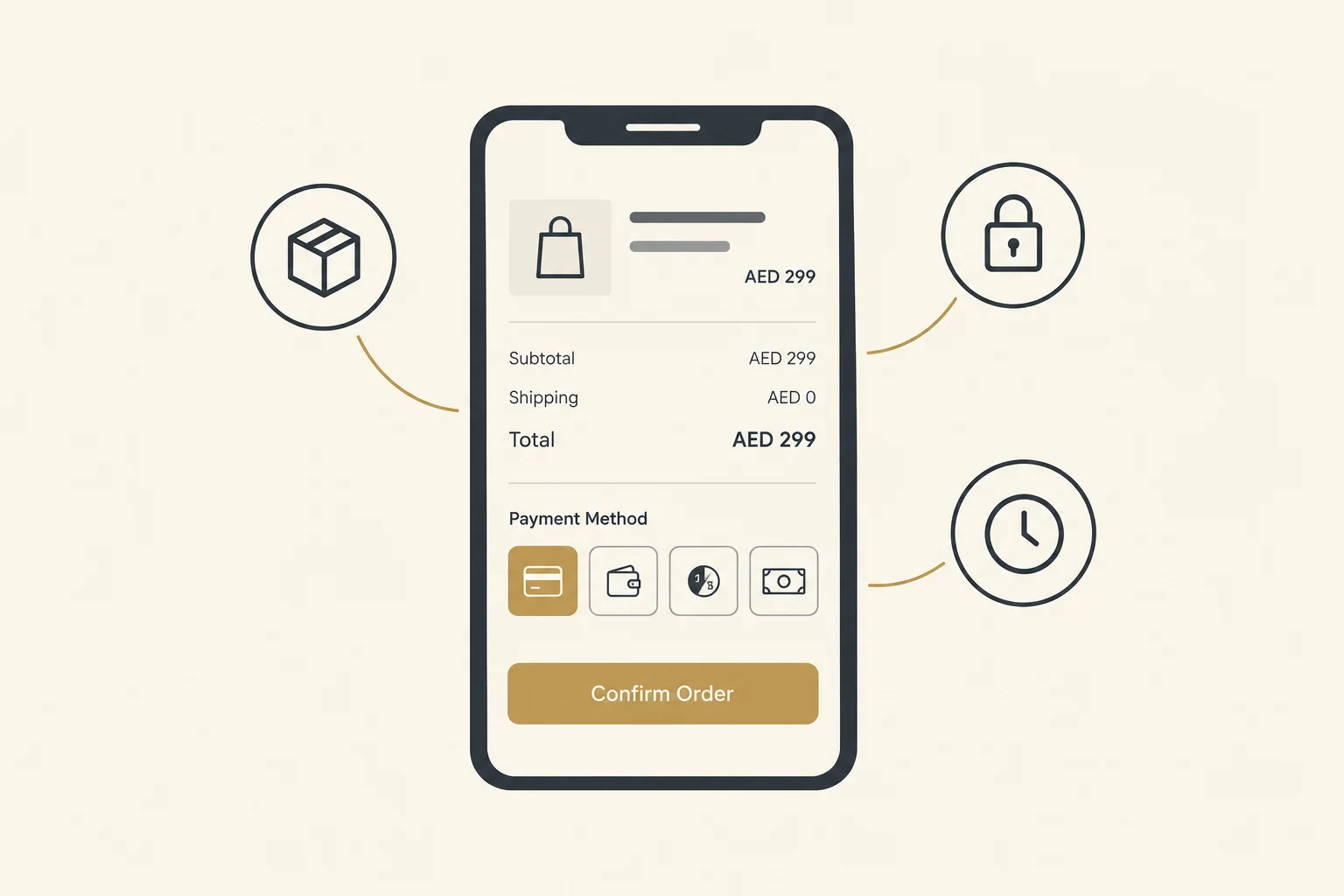
Building an ecommerce website in Dubai is not the same as building one anywhere else. The UAE market has specific requirements, including payment infrastructure, language expectations, mobile behaviour, and consumer trust signals, that a generic ecommerce build simply does not account for. This guide about ecommerce web design Dubai, covers everything you need to know before you brief an ecommerce web design agency in Dubai: which platform to choose, what features matter for UAE consumers, how much it costs, and the mistakes that cause most UAE ecommerce projects to underperform.


Why UAE Ecommerce Is Different From Everywhere Else

The UAE has one of the highest smartphone penetration rates in the world and one of the most digitally active populations in any market. Consumers here shop on mobile, pay with methods that do not exist in Western markets, and increasingly expect to interact with brands in Arabic as well as English.
The ecommerce sites winning in the UAE are not the prettiest ones. They are the fastest, the most trusted, and the most frictionless to buy from. Here is what that means in practice.

Mobile traffic dominates. Over 70% of UAE ecommerce transactions happen on mobile devices. An ecommerce website that looks good on desktop but is slow or awkward on a phone will lose the majority of its potential customers before they reach checkout. Mobile-first design is not a nice-to-have, it is the primary design constraint.

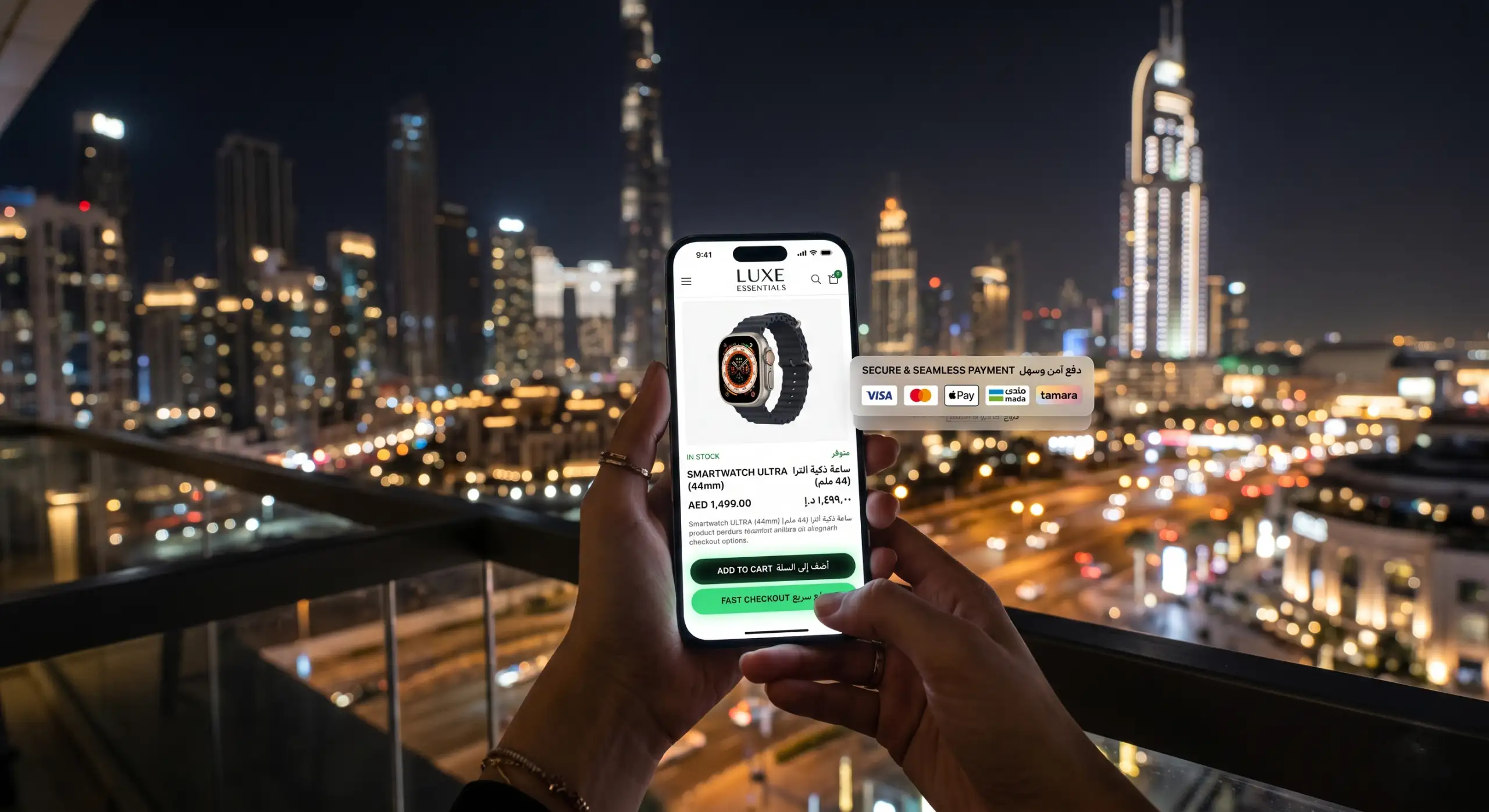
UAE payment expectations are specific. Consumers in the UAE expect to pay via credit card, but also via local gateway solutions. The rapid adoption of buy-now-pay-later options, Tabby and Tamara specifically, has been significant. Studies consistently show that stores offering BNPL in the UAE see meaningful increases in average order value and conversion rate, particularly for products in the AED 200 to AED 2,000 range.

Bilingual is increasingly the standard. The UAE has a large, affluent Arabic-speaking population who prefer to browse and buy in their native language. An Arabic-English ecommerce store, properly designed for right-to-left layout and not simply a translated English store, captures a significantly larger addressable market.


Choosing the Right Ecommerce Platform for UAE

This is the decision most UAE businesses get wrong. The right platform depends on your catalogue size, your technical resources, your timeline, and your specific functionality requirements.

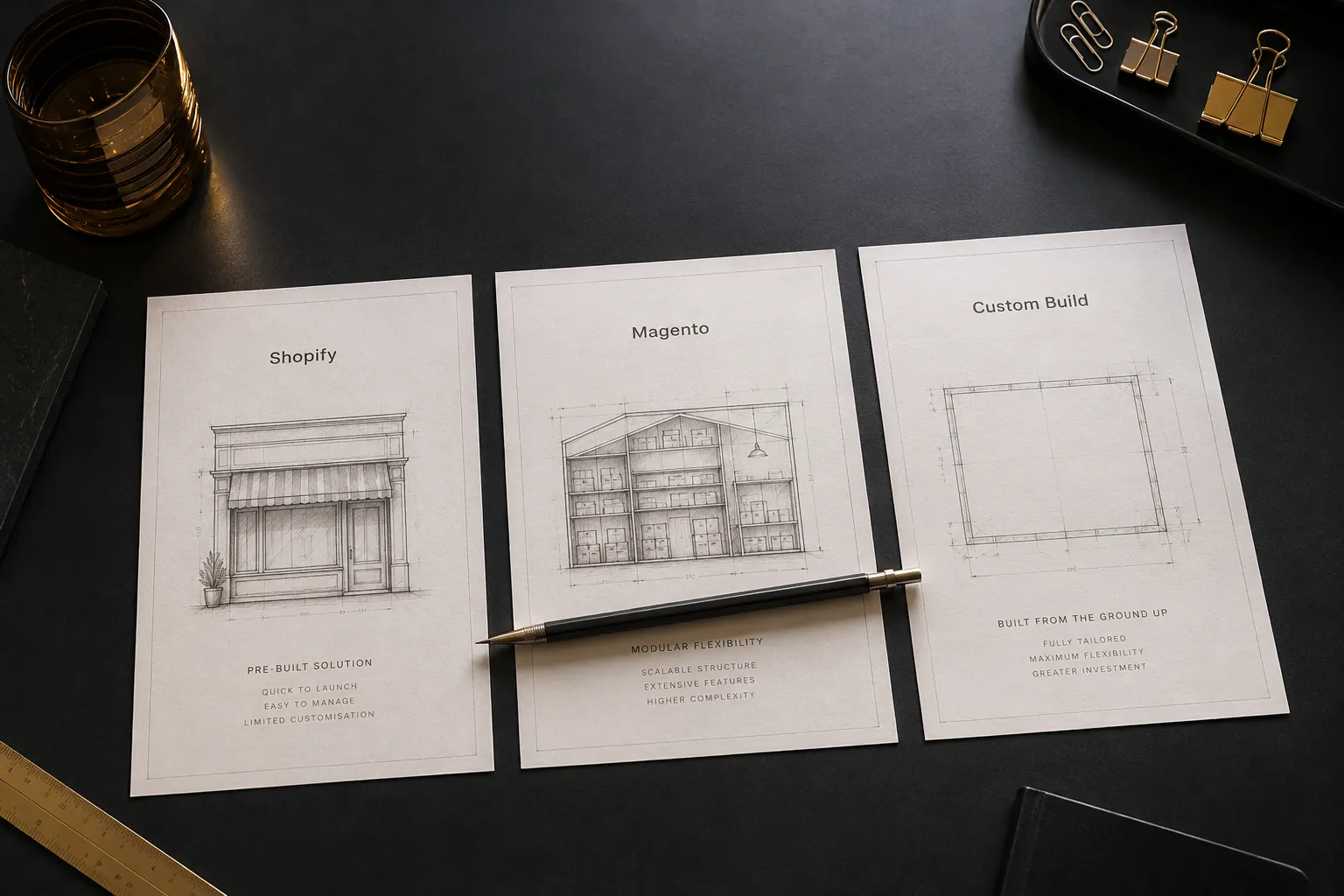
Shopify for most UAE businesses. Shopify is the right starting point for the majority of UAE ecommerce businesses. It is fast to launch, easy to manage without technical expertise, has excellent app ecosystem support for UAE payment gateways, and handles the operational complexity of inventory, orders, and shipping integrations cleanly. Shopify’s mobile storefront performance is industry-leading. For most consumer product businesses in the UAE, Shopify is the answer.

The caveat: Shopify’s customisation ceiling is real. If you have complex pricing rules, tiered B2B pricing, very large catalogues (10,000+ SKUs), or custom checkout logic, you will hit Shopify’s limits and need to work around them expensively.

Magento for enterprise and complex requirements. Magento is the appropriate choice when you need genuine flexibility at scale, including multi-store setups, custom pricing engines, complex inventory hierarchies, or deep ERP integration. It requires more technical investment to build and maintain, but it provides capabilities that Shopify cannot match. If you are a retailer with a large physical operation moving online, or a B2B business with complex ordering requirements, Magento is worth the additional build cost.

WooCommerce when you are already on WordPress. If your business already runs on WordPress and your team knows how to manage it, WooCommerce is a natural extension. The caveat here is performance, WooCommerce requires careful configuration to achieve the page speed scores that UAE mobile users expect. A WooCommerce store built without performance optimisation will be slower than a Shopify equivalent.

Custom platforms when nothing else fits. For businesses with genuinely unique requirements, such as subscription models, marketplace functionality, or complex auction or bidding systems, a custom-built ecommerce platform using Node.js and React gives complete control over performance and logic. This is the highest-cost option and requires an ongoing technical relationship with your development team, but it is the right answer when the requirements genuinely cannot be met by an existing platform.


UAE Payment Gateways: What You Must Integrate

Payment gateway integration is where most UAE ecommerce stores lose customers they have already convinced. A consumer who reaches your checkout and cannot find a payment method they trust will abandon. This is not a hypothetical, UAE cart abandonment rates are high, and payment friction is one of the leading causes.

Network International is the largest payment processor in the UAE and the one most UAE consumers implicitly trust. It is the backbone of most UAE bank card processing.

PayTabs is widely used across the GCC and provides clean integration options for Shopify and Magento. Competitive pricing and good support for UAE business accounts.

Telr and Checkout.com are both solid alternatives used by many UAE ecommerce businesses, particularly those with international ambitions.

Tabby and Tamara, the buy-now-pay-later platforms, are in a category of their own. Tabby in particular has reached significant penetration among UAE consumers. If your products sit in the AED 200 to AED 2,000 range, integrating Tabby will measurably increase your conversion rate. The integration is straightforward on Shopify and Magento.


Arabic RTL: The Detail Most Agencies Get Wrong

Building a bilingual Arabic-English ecommerce store is not a translation project. It is a design project with specific technical requirements that many agencies underestimate.

Arabic reads right-to-left. A proper RTL implementation means the entire page layout mirrors, including navigation on the right, content flowing right to left, and buttons and form fields repositioned. Text alignment changes. Icon direction changes. Number and price formats follow Arabic conventions.

An English store with translated copy bolted on, where the layout remains left-to-right, is immediately obvious to Arabic-speaking users and signals that the brand does not genuinely serve them. In a competitive market where local and regional brands are building genuinely bilingual experiences, this matters commercially.

A properly implemented Arabic RTL design requires the development team to build two distinct layout systems, not one. The best implementations use CSS logical properties and a direction-aware design system that allows both language versions to be maintained from a single codebase. This is the approach Pixtar takes on bilingual ecommerce projects.


How Much Does Ecommerce Web Design in Dubai Cost?

Ecommerce web design in Dubai varies significantly by scope. Here is an honest breakdown.

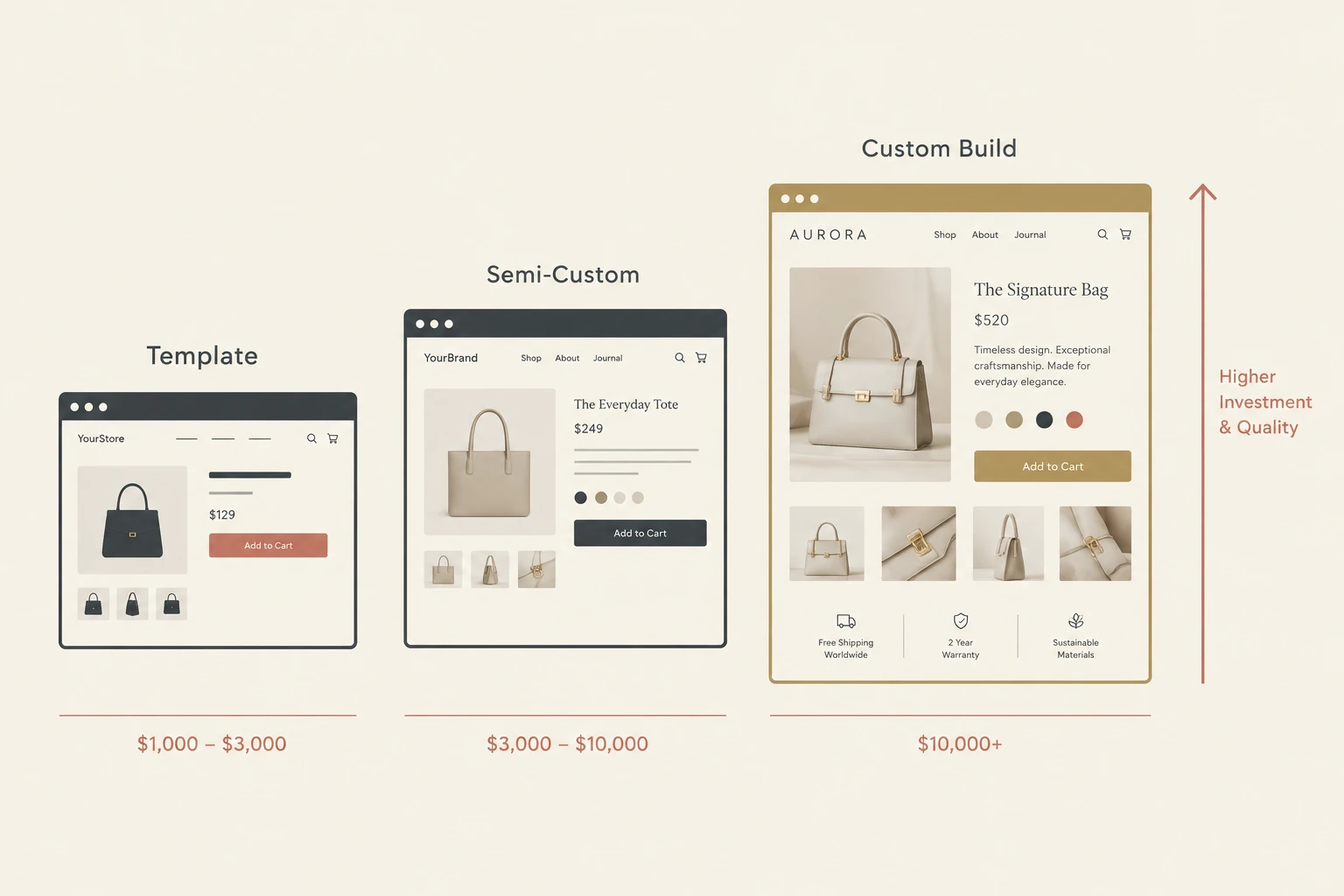
AED 8,000 to AED 15,000: A Shopify store using a premium theme, configured and customised rather than fully custom-built. Includes payment gateway integration, basic product catalogue setup, and standard mobile optimisation. Appropriate for businesses launching a first ecommerce store quickly with a manageable catalogue.

AED 15,000 to AED 40,000: A custom-built Shopify store or entry-level Magento build. Custom theme development, full UAE payment gateway integration including BNPL, Arabic RTL support, and third-party integrations such as logistics, ERP, and email. This is the appropriate range for serious consumer ecommerce in the UAE.

AED 40,000 to AED 100,000+: Complex Magento builds, multi-store setups, B2B ecommerce portals, or fully custom platforms. Enterprise-level requirements with custom pricing logic, deep integrations, and high-volume traffic architecture.

The most common mistake UAE businesses make is choosing a build at the lowest cost tier and then spending a similar amount again six months later to rebuild for performance or additional functionality. Scoping the project correctly from the start, including the payment gateways, the language requirements, and the third-party integrations you will need, is what prevents this.


What to Look for in an Ecommerce Web Design Agency in Dubai

Before you brief an agency, ask these five questions.

Have they built specifically for the UAE market? UAE-specific requirements, including payment gateway integrations, Arabic RTL, and mobile performance for UAE networks, are not generic web development skills. Ask for UAE ecommerce projects in their portfolio.

Do they handle both design and development in-house? Agencies that separate design and development across different teams or outsource one to a third party introduce communication failures that show up as alignment errors, delayed launches, and post-launch performance issues.

What is their process after launch? An ecommerce store does not end at launch. Ask about post-launch support, conversion rate optimisation, and how they handle technical issues once the site is live.

Do they understand ecommerce performance metrics? A good ecommerce agency should talk to you about conversion rate, average order value, cart abandonment rate, and page speed, not just design aesthetics.

Can they show you results, not just portfolios? Ask for specific outcomes from ecommerce projects, not just screenshots of stores, but what happened to the client’s revenue or conversion rate after launch.


Frequently Asked Questions — Ecommerce Web Design Dubai

How long does ecommerce website development in Dubai take?
A standard custom Shopify build takes four to eight weeks. A complex Magento or custom platform takes ten to sixteen weeks. Timeline depends on catalogue size, integration requirements, and content readiness from the client side.

Is Shopify available in the UAE?
Yes. Shopify operates fully in the UAE and supports all major UAE payment gateways including PayTabs, Network International, Tabby, and Tamara. Shopify stores can be set up with a UAE business account and configured for AED pricing.

Do I need an Arabic version of my ecommerce store?
Not necessarily from day one, but it is worth planning for it. The UAE has a large Arabic-speaking population, and Arabic-language ecommerce is growing. If your target customers include UAE nationals and residents who prefer Arabic, a bilingual store will meaningfully expand your addressable market.

What is the difference between ecommerce web design and ecommerce web development?
Ecommerce web design covers the visual layer, including layout, product page experience, checkout UX, and brand presentation. Ecommerce web development is the technical build, including the code, integrations, performance, and platform configuration. The best outcomes come from agencies that handle both under one roof.

Can Pixtar rebuild an underperforming ecommerce store?
Yes. We handle full ecommerce rebuilds, improving design, performance, and conversion rate while migrating existing products, customer data, and order history. We preserve your URL structure to protect existing search rankings.


Get an ecommerce web design quote from Pixtar

3 Signs It’s Time to Redesign Your E-commerce Website

e-commerce website redesign

In today’s digital marketplace, your e-commerce website act as both your storefront as well as your primary salesperson. The first impressions are made in few seconds online, and your e-commerce store is first impression of your brand online. If your website feels outdated, performs poorly, or no longer aligns with customer expectations, it could be quietly costing you sales, damaging your credibility and holding back your growth. Redesigning e-commerce website isn’t something which can be done as you wish; it should be done knowing when it’s necessary, will make a big difference. In this article, we will explore 3 signs that it’s time to consider an e-commerce website redesign.

First let us understand,

Why E-commerce Website Redesign is Important?

E-commerce website is not a one time project. Your e-commerce website needs to stay relevant with technology, user expectations and design trends. This will help your e-commerce website to boost your search engine ranking, improves user experience, increases sales and your brand’s online reputation. Failing this will lead to customers to lose trust, search engines to lower your rankings, and competitors to capture your market share.

3 Signs you need an E-Commerce Website Redesign!

1. Declining Sales and Conversions

Are you facing the problem of decreased sales? If your website is attracting traffic but struggling to turn into customers, then your website is likely having problem in buying process.

Common issues are:

  • A confusing or lengthy checkout process
  • Poor product page layouts
  • Lack of clear calls-to-action (CTAs)
  • Slow site speed
  • Broken trust signals. For example, missing reviews or outdated security badges.

Online shoppers expect fast, seamless transactions. According to studies, 70% of online shopping carts are abandoned before checkout due to poor user experience. Your checkout process shouldn’t be complicated or else your customers will turn to your competitors. This is an important sign you need to have an e-commerce website redesign.

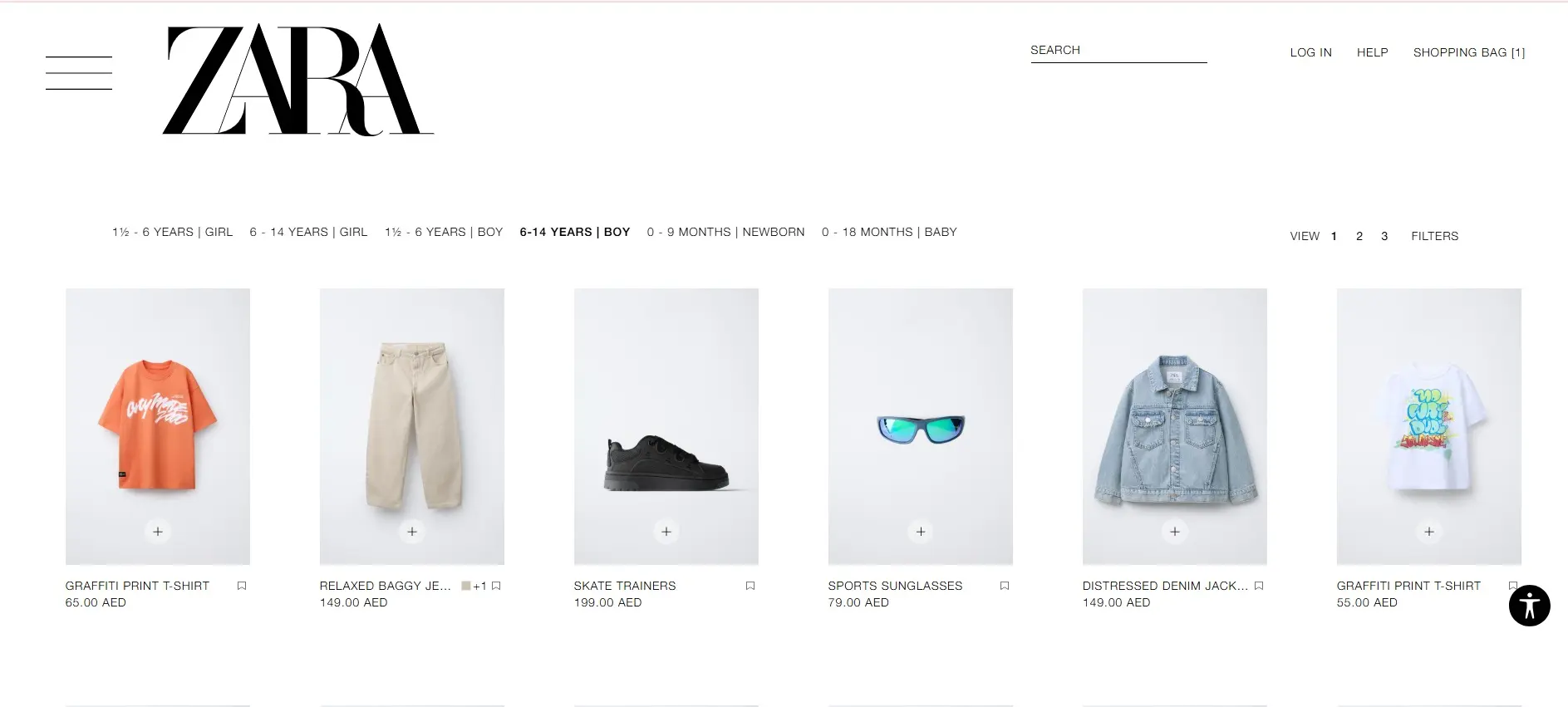
Example: Let’s understand this by taking reference from the ZARA website, which is doing right in 2025.

Image Source : ZARA Website

i. Smooth Checkout Experience

  • No forced account creation here, because guest checkout available.
  • Minimal steps: shipping → payment → confirmation (all in one streamlined flow).
  • Multiple payment options are available for example, Apple Pay, Google Pay, PayPal, credit/debit cards.
  • Auto-fill support for faster checkout.

ii. Product Pages

  • Large, high-quality images with zoom and video previews.
  • Clean, uncluttered layout with clear pricing, sizing, and availability.
  • Consistent, high-end feel matching Zara’s brand.
  • Size guides, model fit details, and product care instructions included.

iii. Strong CTAs

  • Quick-add options on category and search pages.
  • No unnecessary distractions around the purchase funnel.

iv. Fast Site Speed

  • Optimized images and content delivery.
  • Fast loading times even on mobile data connections.
  • Consistently excellent Core Web Vitals performance.

v. Excellent Trust Signals

  • Secure checkout (SSL, payment badges).
  • Return policy displayed clearly on product pages.
  • Easily accessible customer support.
  • Product reviews and ratings visible where applicable.

2. Outdated Design and Branding

Your website’s visual appearance is a reflection of your brand’s professionalism and credibility. Even if your products and services are top-tier, an outdated design can make visitors question your trustworthiness.

Signs your design may be outdated:

  • Cluttered or overly busy layout
  • Inconsistent color schemes or typography
  • low-quality images
  • Old-fashioned interface elements
  • Lack of modern design trends like minimalism, whitespace, or micro-interactions

Consumers today expect sleek, intuitive designs that are visually appealing while providing clear information. If your website looks like it hasn’t been updated in years, it may be sending the wrong message to potential buyers.

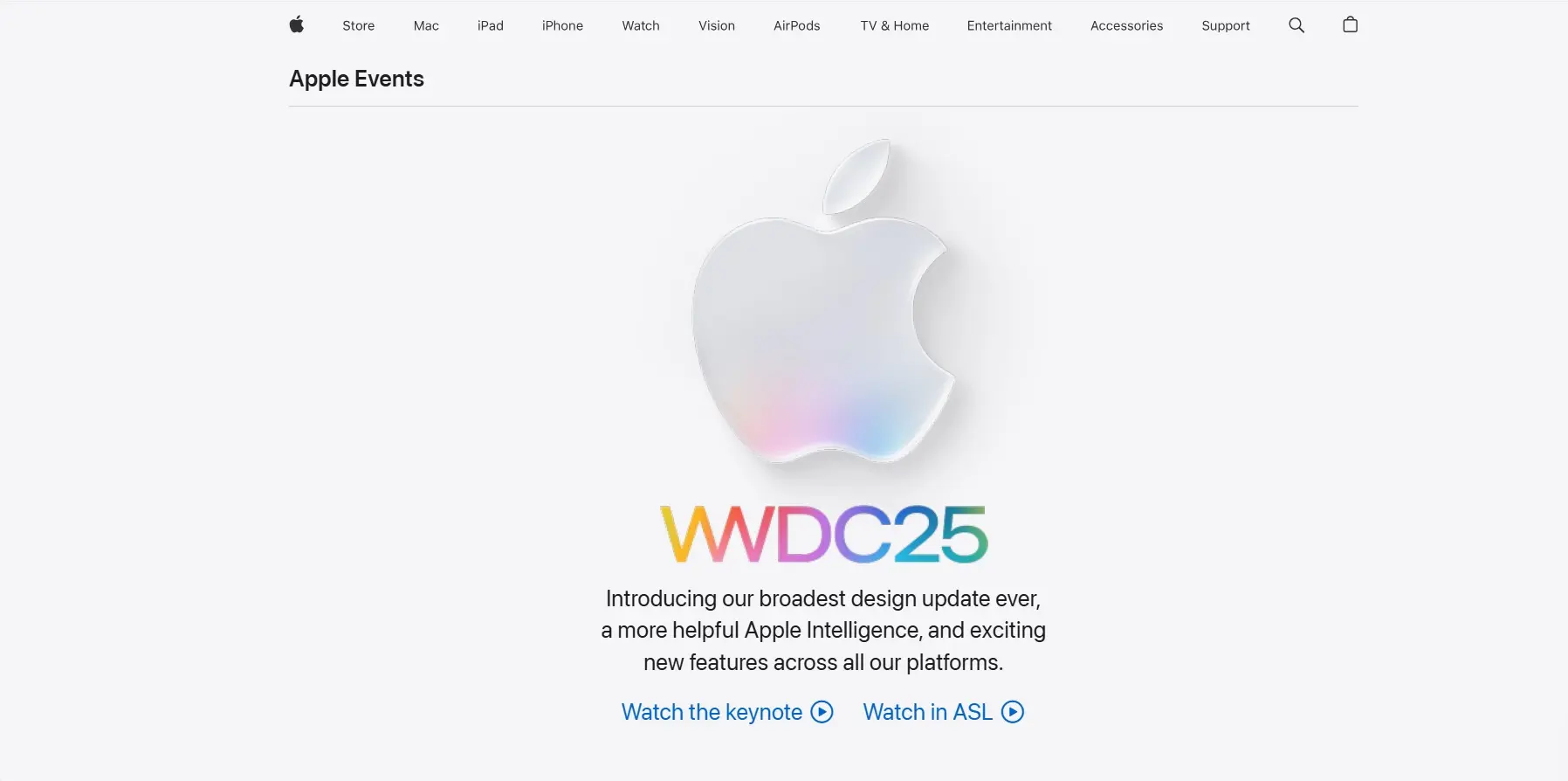
Take the example of Apple’s e-commerce store, which has

Image Source : Apple

i. Consistent Branding Across the Entire Experience

  • In Apple’s e-commerce website: every page, product, and button reflects Apple’s brand voice which is premium, modern, and simple.
  • Unified fonts, colors, spacing, and design elements throughout the site.
  • High-end feel that matches their physical stores and overall brand identity.

ii. Clean, Minimalist Design

  • Heavy use of whitespace draws attention to product visuals.
  • Clear, simple layouts free of clutter or unnecessary text.
  • Focus is on showcasing the product, not overwhelming users with options.

iii. High-Quality, Sharp Visuals

  • Pixel-perfect product photography.
  • Retina-optimized images and videos.
  • 360-degree product views and detailed product demo videos.

iv. Modern UI/UX Elements

  • Sticky navigation bars that make it easy to browse.
  • Clear breadcrumb navigation without unnecessary distractions.
  • Seamless transitions paired with elegant micro-interactions across buttons, menus, and galleries.

v. Instant Trust-Building Visual Experience

  • Secure, modern checkout experience.
  • Clear pricing, specs, warranty info, and support details.
  • Transparent policies fully integrated into the shopping experience

3. Poor Mobile Experience

More than half of online shopping happens on mobile devices; your e-commerce store must deliver a seamless mobile experience. Google also uses mobile-first indexing, meaning your mobile site’s performance directly affects your search rankings.

Common mobile issues include:

  • Pages that don’t scale properly to mobile screens
  • Small or hard-to-tap buttons
  • Slow loading times
  • Difficult navigation
  • Poor image optimization

Even minor mobile issues can cause potential customers to leave your site and can lead to lost sales. Your website must load quickly, display correctly, and remain easy to navigate on any device, or you risk alienating a significant portion of your audience.

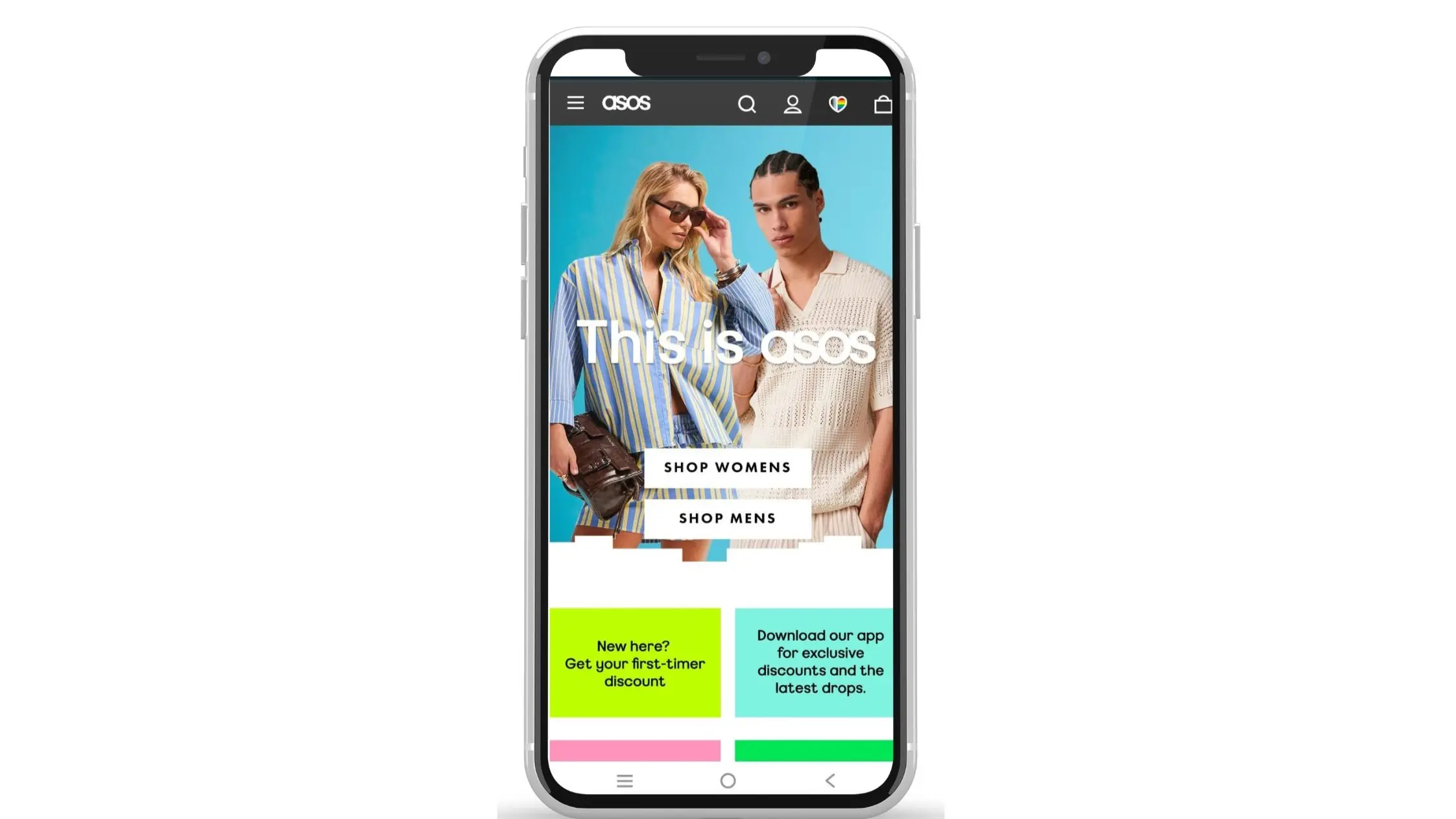
We will look into ASOS as an example. It is

i. Fully Mobile-First Design

  • ASOS has designed its entire e-commerce store around mobile-first principles.
  • Pages scale perfectly on any screen size, from smartphones to tablets.
  • When the user rotate or resize the device the responsive layout adjusts accordingly.

ii. Smooth, Intuitive Navigation

  • Clean, collapsible menus optimized for thumbs.
  • Filters and search functionality that remain easily accessible without much scrolling.
  • It has sticky headers with easy category access and search bar.

iii. Fast Load Times

  • Excellent mobile Core Web Vitals performance.
  • Image optimization with modern formats like WebP.
  • Lazy loading is used properly to prioritize content that users will see first.

iv. High-Quality Visuals

  • Crisp, optimized product images even on mobile data.
  • Image zoom and video previews that work smoothly on smaller screens.
  • No pixelation or broken layouts.

v. Easy Mobile Checkout

  • Guest checkout enabled.
  • Seamless mobile wallet integrations with online payment like Apple Pay, Google Pay.
  • One-click address autofill and secure payment gateways.

The Cost of Waiting Too Long

Many businesses postpone redesigning their e-commerce website due to perceived costs or time investment. But delaying often leads to larger financial losses down the road.

  • Risks of postponing a redesign include:
  • Steady decline in search engine rankings
  • Higher customer acquisition costs due to poor conversions
  • Damage to brand reputation
  • Increased maintenance costs as old systems break down
  • Loss of competitive edge

Investing in an e-commerce website redesign early can protect your business, boost long-term revenue, and position your brand for growth in a rapidly evolving marketplace.

Conclusion

Your e-commerce website isn’t just a storefront—it’s the heart of your online business. If you’re experiencing any of these three signs, it’s likely time to take action. A modern, conversion-focused redesign can unlock new growth opportunities, improve your customer experience, and strengthen your brand.

At Pixtar, we specialize in building modern, high-performing e-commerce websites that help businesses like yours thrive. Whether you’re looking for a complete redesign or targeted improvements, our expert team is ready to help you create an online store that truly works for you. Contact Pixtar today!

The Best AI Chatbot for E-commerce Platforms

AI chatbot for ecommerce

The Rise of AI Chatbots in ecommerce

The development of ecommerce technology continues at a quick pace as customers execute new demands on the market. Customers expect immediate customer support, personalized product suggestions as well as instant helpful responses. The best human teams unfortunately fail to maintain this level of service at a large scale.

A solution arrives through the implementation of AI chatbots.

Modern AI chatbot for ecommerce provide more functionality than automated script replication. These systems use advanced intellect while making efficient operations possible. Your digital team of salesforces operates continuously to provide:

– Guide product discovery

– Upsell and cross-sell in real-time

– Resolve customer issues instantly

– Your sales can recover lost cart purchases through on-time alert notifications to customers.

If you’re not using the AI chatbot for ecommerce yet, you are missing a massive opportunity to convert, retain, and delight your customers.

Why You Need a Chatbot on Your ecommerce Platform

AI chatbot for ecommerce represent necessity for modern ecommerce achievement because these systems deliver three core benefits.

1. 24/7 Customer Support

Customers perform their shopping activities at all hours, across time zones. Your chatbot operation permits business availability round the clock regardless of employee work hours.

2. Higher Conversions & Sales

Your AI chatbot for ecommerce technology performs the same functions as an excellent in-store assistant thanks to its ability to recommend products and solve questions, and push customers towards shopping checkouts.

3. Personalized Shopping Experience

AI-powered chatbots analyze customer web activity along with order records to deliver customized care which feels personalized for every visitor.

4. Reduced Operational Costs

Why scale your team when a smart chatbot can handle 70–80% of repetitive tasks—instantly and without errors?

5. Multilingual Communication

Global reach = global responsibility. A top AI chatbot for ecommerce works with more than thirty different native languages for instant use.


Features to Look For in the Best AI Chatbot for ecommerce

Not all bots are built the same. Here’s what separates the best from the rest:

  • Seamless integration with Shopify, Magento, etc.
  • AI & machine learning to improve responses over time
  • Live chat handover for complex queries
  • Analytics dashboard to measure ROI and user satisfaction
  • Abandoned cart recovery flows
  • Pre-built templates for fast onboarding

Top 5 AI Chatbot for ecommerce in 2025

Here’s a curated list of standout tools trusted by modern ecommerce businesses:

1. Tidio

A hybrid chatbot/live chat tool that integrates easily with Shopify and WordPress. Ideal for small-to-mid businesses wanting fast setup and great UX.

2. Gorgias

Built for Shopify and geared toward customer support. Offers AI-driven ticket handling and deep order data access inside chats.

3. ManyChat

If you’re big on social selling (Instagram, Facebook), ManyChat is a game-changer. Automate Messenger campaigns and drive more conversions.

4. Botsonic by Writesonic

No-code, GPT-powered chatbot builder. Great for mid-market brands that want to train bots on custom data with conversational AI flair.

5. Zendesk AI

For larger operations, Zendesk’s AI suite adds chat automation layered into your existing customer service system, with robust ticketing and reporting.


Real Business Benefits

Let’s talk numbers. Brands using AI chatbot for ecommerce report:

  • Up to 30% increase in conversion rates
  • 60–80% reduction in live support workload
  • 2–3x higher response speed for pre-sales queries
  • Improved customer satisfaction (CSAT) scores by 25%+

AI bots not only boost revenue—they free up your team to focus on higher-impact work.


How to Choose the Right AI Chatbot for Your Store

Before diving in, ask yourself:

  • What platform do I use (Shopify, Magento, or custom)?
  • Who is my audience, and what are their expectations?
  • Am I scaling fast? Will my chatbot grow with me?
  • What’s my budget—and will this tool provide measurable ROI?

Pro tip: Most top chatbot platforms offer free trials. Test drive a few and compare response quality, UX, and integration depth before committing.


Final Thoughts: The Future is Automated—and Personal

In a space where milliseconds matter, automation is your edge. But with the right AI chatbot, automation doesn’t mean impersonal—it means smarter, faster, and more customer-centric service.

So, whether you’re building your first online store or scaling a global DTC brand, now’s the time to get your AI chatbot in place. It’s not just about keeping up—it’s about standing out.

Let your chatbot handle the clicks while you focus on the big-picture moves.


Ready to Elevate Your ecommerce Game?

Explore the best AI chatbot tools, integrate the one that fits your brand, and start turning conversations into conversions—automatically.

Try Before You Buy: How AR is Enhancing Online Shopping

Augmented Reality in eCommerce

As you know shopping online is super convenient now a days, but there’s always a risk—you can’t touch, try on, or see the product in real life before buying. There are several questions asked to oneself, What if that couch doesn’t match our living room? What if those sunglasses don’t suit my face? This uncertainty leads to hesitation, and in many cases, returns. That’s where Augmented Reality (AR) comes in. AR is changing the game by allowing shoppers to “try before they buy”—virtually. AR is making online shopping feel more real and trustworthy from trying on clothes and makeup to placing furniture in your home, Augmented Reality is making online shopping feel more real and trustworthy.

In this blog, we will deal with how Augmented Reality is improving the ecommerce experience, making shopping more interactive, and then why it’s becoming a must-have technology for online stores.

How Augmented Reality Works in Online Shopping

Augmented Reality blends the digital and real world by overlaying virtual objects in a real-life environment. In online shopping, AR is used in different ways to help customers visualize products before making a purchase. Here are some of the most popular applications:

1. Virtual Try-On for Clothing and Accessories

Ever wondered how a pair of glasses would look on your face before buying them online? AR-powered virtual try-ons make this possible. Many brands now offer face-scanning technology that lets users see how sunglasses, hats, or even makeup will look on them in real time.

Companies like Warby Parker and Ray-Ban have introduced AR-based try-on features, making it easier for customers to choose the perfect style without visiting a store.

2. Makeup and Beauty Product Try-On

Buying makeup online has always been tricky. What if the lipstick shade looks different in real life? AR-powered beauty apps let users apply virtual makeup to their faces using their phone cameras. Brands like Sephora and L’Oréal have integrated AR into their apps, allowing shoppers to experiment with different shades and products before purchasing.

3. Placing Furniture in Your Home

One of the biggest challenges of buying furniture online is knowing how it will fit and look in your space. AR apps from companies like IKEA and Wayfair let users place virtual furniture in their rooms using their phone cameras. This way, you can check the size, color, and style before buying.

4. Trying On Shoes and Apparel

Many shoe brands are now offering AR-powered foot scanning technology that helps customers find the perfect fit. Companies like Nike and Adidas use AR to let shoppers virtually try on sneakers, reducing the chances of ordering the wrong size.

5. Previewing Home Décor and Paint Colors

Choosing the right home décor or paint color online is tough. What looks great on a website might not suit your actual space. AR apps from brands like Dulux and Home Depot allow users to visualize paint colors on their walls or see how artwork and décor pieces will look in their homes.

Why AR is a Game-Changer for Online Shopping

1. Reduces Uncertainty and Boosts Confidence

One of the biggest reasons people hesitate to shop online is the fear of buying the wrong product. AR eliminates this guesswork by letting customers see how items will look or fit before making a decision. This builds confidence and leads to fewer abandoned carts.

2. Reduces Return Rates

Returns are a major headache for both customers and retailers. A product that doesn’t match expectations leads to dissatisfaction and extra costs for shipping and restocking. With Augmented Reality, shoppers are less likely to order the wrong size, color, or style, significantly reducing returns.

3. Creates an Engaging and Fun Shopping Experience

AR makes shopping interactive and enjoyable. Instead of just scrolling through product images, users can actively engage with products—whether it’s trying on a dress or placing a new sofa in their living room. This level of interaction makes online shopping more fun and engaging.

4. Saves Time for Customers

No need to visit multiple stores or spend hours reading reviews to guess how something will look in real life. Augmented Reality(AR) allows shoppers to make quicker decisions because they can see products in action instantly.

5. Gives Brands a Competitive Edge

eCommerce is highly competitive, and brands that adopt AR technology stand out from the crowd. By offering a more immersive shopping experience, businesses can attract more customers and build stronger brand loyalty.

Challenges of Augmented Reality in eCommerce

While AR is transforming online shopping, it’s not without challenges:

Technology Limitations: AR features require high-quality 3D models and advanced programming, which can be costly for smaller businesses.

Device Compatibility: Not all users have AR-compatible smartphones, which limits accessibility.

Learning Curve for Users: Some customers may not be familiar with AR features and need guidance on how to use them effectively.

Despite these challenges, the benefits far outweigh the drawbacks, and as technology advances, AR is expected to become even more accessible.

The Future of AR in Online Shopping

The use of augmented reality in e-commerce is only going to grow. Here’s what we can expect in the coming years:

More Personalized Experiences: AI-powered AR will offer recommendations based on user preferences and past purchases.

Better Accuracy and Realism: Advancements in AR technology will make virtual try-ons look even more lifelike.

Integration with Smart Mirrors and Wearables: In the future, AR shopping experiences may extend to smart mirrors in physical stores or AR glasses for hands-free virtual try-ons.

Retailers that embrace Augmented Reality now will be ahead of the curve, offering customers an interactive and seamless shopping journey.

Conclusion

Augmented Reality is revolutionizing the way we shop online. By allowing customers to try before they buy, AR reduces uncertainty, lowers return rates, and makes online shopping more engaging. Whether it’s trying on clothes, testing makeup, or visualizing furniture, AR is helping shoppers make smarter purchasing decisions.

As more brands adopt this technology, we can expect a future where online shopping feels just as real—if not better—than shopping in a physical store. If you haven’t experienced AR shopping yet, now is the time to give it a try!

Custom eCommerce Web Development: Solutions for Online Success

custom ecommerce web development
Introduction

In the bustling world of online retail, one-size-fits-all solutions don’t always deliver the competitive edge you need. Custom eCommerce web development offers a tailored approach, building platforms that align perfectly with your business goals, audience preferences, and industry requirements. Let’s delve into why custom eCommerce web development is the ultimate choice for businesses aiming to stand out.

Custom eCommerce Web Development: What Does It Mean?

Custom eCommerce web development involves creating a fully tailored online store from scratch or extensively modifying existing platforms to suit unique business needs. Unlike off-the-shelf templates, custom web development ensures every feature, function, and design element reflects your brand identity and operational goals.

Why Choose Custom eCommerce Web Development?
  1. Personalized User Experience:

Custom platforms enable the sellers to create such journey maps and interfaces that are unmatched by competitors and well match the needs of consumers, thereby, the engagement and conversion rates are higher.

2. Scalability for Growth:

When the business keeps expanding, an in-house solution can gradually add new features, products, and integrations, while at the same time, it can also be nimble enough to support changes over time.

3. Enhanced Performance:

With the use of custom codes, you can ensure the site performance levels are high (thus there are lower loading time, and easy navigation and the user experience is catered to improve the overall user experience).

4. Advanced Integrations:

Customized solutions can be connected to third-party CRMs, ERPs, and advanced analytics without any stress, making a single business run smoothly.

5. Unique Branding:

Stand out in a crowded market with a website that reflects your brand’s identity, vision, and values, creating a memorable customer experience.

Essential Features of a Custom eCommerce Platform
  1. Customizable Product Catalog:

Dynamic product categories, filters, and displays designed to simplify browsing for your customers.

2. Tailored Checkout Process:

Provide a smooth checkout experience by allowing the customers to choose from different customizing options such as one-click buying, guest type checkout, and personal ways of payment.

3. Responsive and Mobile-Optimized Design:

Deliver beyond expectation across all platforms with a design that features auto adjustments according to different display sizes.

If you’re looking to enhance user experience and ensure your website performs seamlessly across all devices, understanding the nuances of responsive web design is crucial. Discover how responsive web design can revolutionize your online presence by reading our detailed blog: Responsive Web Design in Dubai.

4. Robust Security Measures:

Custom-made solutions allow for the implementation of the latest security features which include such things as encrypted payment gateways, multi-factor authentication, and secured data storage.

5. AI-Driven Personalization:

Use AI to bring tailored product recommendations, dynamic pricing, and predictive analytics.

Benefits of Investing in Custom eCommerce Web Development
  1. Competitive Advantage:

A personalized platform allows you to position yourself in the neck-of-the-woods of the e-commerce market.

2. Future-Proof Design:

Custom solutions are constructed with scalability which means the coming expansion of your business can be realized.

3. Increased ROI:

By personalizing your platform to the customer, you facilitate their engagement, satisfaction and ultimately conversion.

4. Complete Control:

Experience the privilege of a full customization on design, functions, and data, thus, your platform will trail your agenda.

How to Get Started with Custom eCommerce Web Development?
  1. Define Your Goals:

In an explicit way, set your business objectives, your target audience and must-have features.

2. Choose the Right Partner:

Tie up with a talented development team who can interpret your vision and implement it through a high-performing platform.

3. Plan for the Long Term:

Mainly consider the expansion of the platform by making sure that your e-commerce platform is scalable to the technological developments.

4. Test Thoroughly:

Let stringent testing be conducted in order to ensure perfect functionality, security, and user experience.

Conclusion

Custom eCommerce web development is the solution to creating a special and unforgettable digital experience. By creating a platform that is specific to your business and your audience, you provide a foundation that will be sustainable in the long term. Are you ready to fashion an eCommerce website that is indeed your own?

Transform your vision into reality with Pixtar’s custom eCommerce web development solutions. Contact us today to build an online store that drives results!

Elevate Your eCommerce With Custom Websites this year

Ecommerce website illustration

Introduction

If you’re like most business owners, you’re always looking for ways to take your eCommerce platform to the next level. One great way to do that is by creating custom website for your business. In this article, we’ll discuss the benefits of doing just that in 2023.

When it comes to eCommerce, a custom website can be a real game changer. For starters, it can help you stand out from the competition. With a unique website, you’ll be able to showcase your brand in a way that’s truly unique and memorable. Plus, a custom website can help improve your customer’s overall shopping experience. Not sure where to start? Don’t worry! We’ll show you how to create a custom website that’s perfect for your business. So, what are you waiting for? Read on for more information!

What You Stand to Gain from Custom Websites for eCommerce

You’re probably aware that custom websites can be a powerful asset for eCommerce businesses. In fact, studies show that businesses who invest in custom websites enjoy a wide range of benefits, including:

• Increased brand awareness and customer loyalty

• Enhanced website usability and user experience

• More effective online marketing and lead generation

• Greater website search engine visibility and ranking

And that’s just the beginning. When you work with a professional web design company to create a unique and tailored website for your eCommerce business, you can expect even more advantages. So, what are you waiting for? Invest in your business’s future today!

Benefits of Tailored eCommerce Websites

Creating a unique and tailored eCommerce website can help your business take its online platform to the next level in 2023. There are many benefits to be had when you go beyond the cookie-cutter websites that are so common in the eCommerce world today.

When you have a unique and custom website, you stand out from the competition. Your website is an extension of your brand, and it tells your customers who you are and what you’re all about. A cookie-cutter website simply won’t do that justice.

What’s more, a custom website can help increase your sales and conversions. It’s been proven that when customers see a well-designed, unique website, they are more likely to trust the brand and make a purchase. In fact, a study by Salesforce found that 78% of customers judge a company by its website design. So, if you want to take your eCommerce business to the next level in 2022, make sure to create a unique and tailored website that represents your brand well.

Identifying Your Brand and Creating a Unique Look

When you’re starting an eCommerce business, the very first thing you need to do is create a brand. This means developing a unique look and feel that will help you stand out from the competition.

But how do you do that? One of the best ways is to create a unique website. Not only will this be more attractive to customers, but it will also help you rank higher in search engine results pages. So how do you go about creating a custom website for your business? The best place to start is by identifying your brand. What are your core values? What makes you different from the competition? Once you have a better understanding of this, you can start translating it into a visual aesthetic that will be sure to impress customers and help your business stand out from the rest.

Design Approaches for Achieving the Perfect Balance

Creating an eCommerce website that is both unique and tailored to your brand can be a daunting task. There are many designs approaches you can take to achieve the perfect balance for your business. The following factors should be considered when determining the best design approach for your eCommerce website:

– The overall look and feel of your website

– The products and services you offer

– Your target audience

– Your budget

Once you have considered these factors, you can begin to experiment with different design approaches. Some common design approaches for eCommerce websites include using a pre-made theme, hiring a web designer, or using an eCommerce platform that provides templates.

If you want to take your eCommerce website to the next level this year, consider creating a unique and tailored website. By doing so, you will be able to stand out from the competition and provide your customers with a truly one-of-a-kind shopping experience.