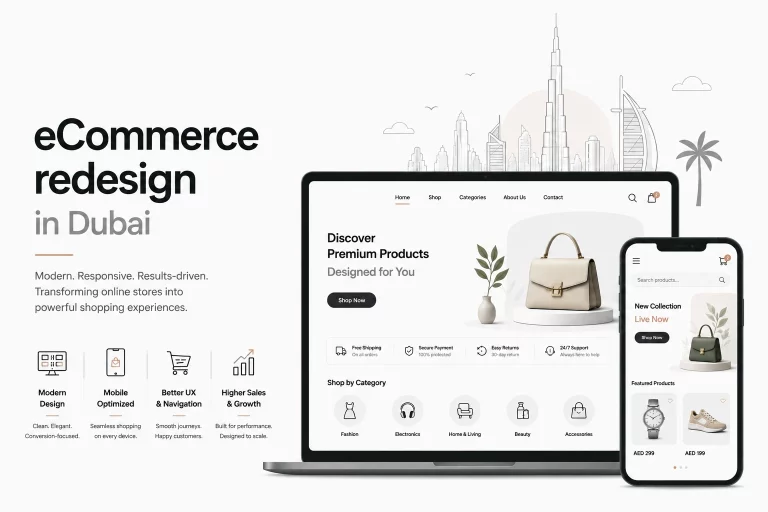
Building an ecommerce website in Dubai is not the same as building one anywhere else. The UAE market has specific requirements, including payment infrastructure, language expectations, mobile behaviour, and consumer trust signals, that a generic ecommerce build simply does not account for. This guide about ecommerce web design Dubai, covers everything you need to know before you brief an ecommerce web design agency in Dubai: which platform to choose, what features matter for UAE consumers, how much it costs, and the mistakes that cause most UAE ecommerce projects to underperform.
Why UAE Ecommerce Is Different From Everywhere Else
The UAE has one of the highest smartphone penetration rates in the world and one of the most digitally active populations in any market. Consumers here shop on mobile, pay with methods that do not exist in Western markets, and increasingly expect to interact with brands in Arabic as well as English.
The ecommerce sites winning in the UAE are not the prettiest ones. They are the fastest, the most trusted, and the most frictionless to buy from. Here is what that means in practice.
Mobile traffic dominates. Over 70% of UAE ecommerce transactions happen on mobile devices. An ecommerce website that looks good on desktop but is slow or awkward on a phone will lose the majority of its potential customers before they reach checkout. Mobile-first design is not a nice-to-have, it is the primary design constraint.
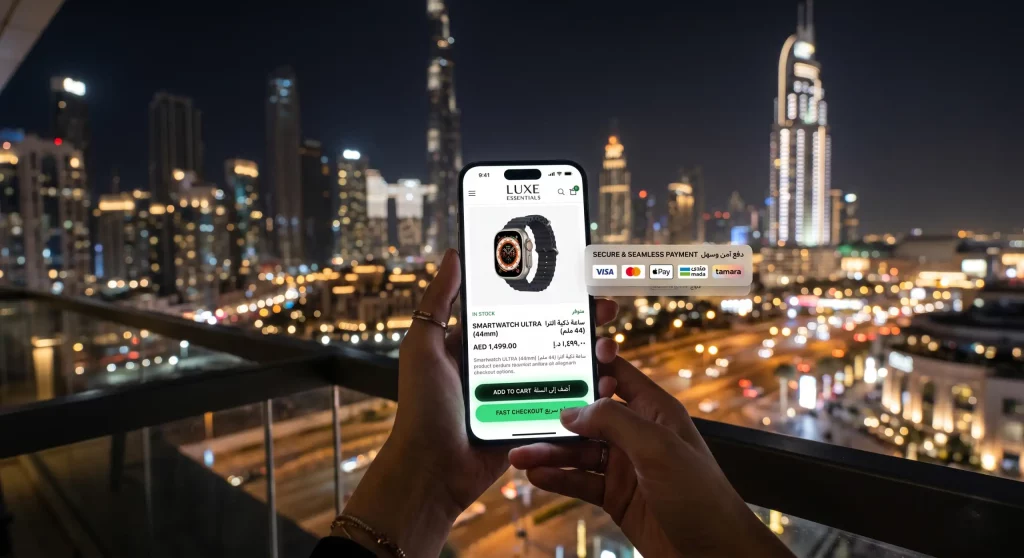
UAE payment expectations are specific. Consumers in the UAE expect to pay via credit card, but also via local gateway solutions. The rapid adoption of buy-now-pay-later options, Tabby and Tamara specifically, has been significant. Studies consistently show that stores offering BNPL in the UAE see meaningful increases in average order value and conversion rate, particularly for products in the AED 200 to AED 2,000 range.
Bilingual is increasingly the standard. The UAE has a large, affluent Arabic-speaking population who prefer to browse and buy in their native language. An Arabic-English ecommerce store, properly designed for right-to-left layout and not simply a translated English store, captures a significantly larger addressable market.
Choosing the Right Ecommerce Platform for UAE
This is the decision most UAE businesses get wrong. The right platform depends on your catalogue size, your technical resources, your timeline, and your specific functionality requirements.
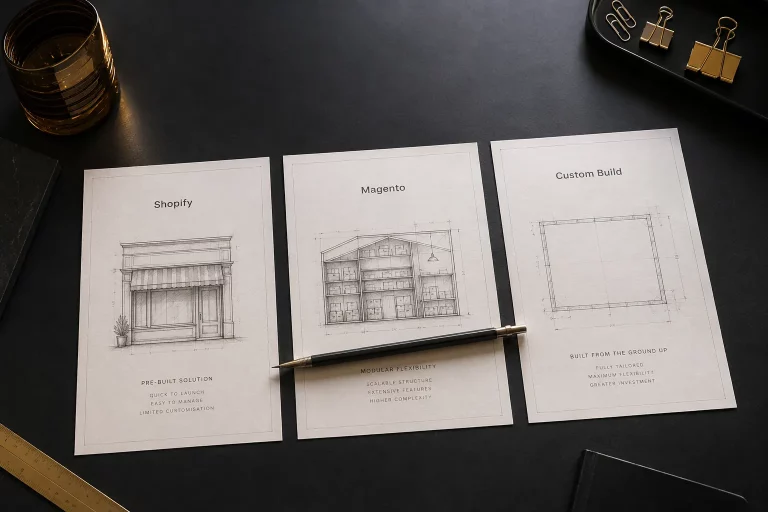
Shopify for most UAE businesses. Shopify is the right starting point for the majority of UAE ecommerce businesses. It is fast to launch, easy to manage without technical expertise, has excellent app ecosystem support for UAE payment gateways, and handles the operational complexity of inventory, orders, and shipping integrations cleanly. Shopify’s mobile storefront performance is industry-leading. For most consumer product businesses in the UAE, Shopify is the answer.
The caveat: Shopify’s customisation ceiling is real. If you have complex pricing rules, tiered B2B pricing, very large catalogues (10,000+ SKUs), or custom checkout logic, you will hit Shopify’s limits and need to work around them expensively.
Magento for enterprise and complex requirements. Magento is the appropriate choice when you need genuine flexibility at scale, including multi-store setups, custom pricing engines, complex inventory hierarchies, or deep ERP integration. It requires more technical investment to build and maintain, but it provides capabilities that Shopify cannot match. If you are a retailer with a large physical operation moving online, or a B2B business with complex ordering requirements, Magento is worth the additional build cost.
WooCommerce when you are already on WordPress. If your business already runs on WordPress and your team knows how to manage it, WooCommerce is a natural extension. The caveat here is performance, WooCommerce requires careful configuration to achieve the page speed scores that UAE mobile users expect. A WooCommerce store built without performance optimisation will be slower than a Shopify equivalent.
Custom platforms when nothing else fits. For businesses with genuinely unique requirements, such as subscription models, marketplace functionality, or complex auction or bidding systems, a custom-built ecommerce platform using Node.js and React gives complete control over performance and logic. This is the highest-cost option and requires an ongoing technical relationship with your development team, but it is the right answer when the requirements genuinely cannot be met by an existing platform.
UAE Payment Gateways: What You Must Integrate
Payment gateway integration is where most UAE ecommerce stores lose customers they have already convinced. A consumer who reaches your checkout and cannot find a payment method they trust will abandon. This is not a hypothetical, UAE cart abandonment rates are high, and payment friction is one of the leading causes.
Network International is the largest payment processor in the UAE and the one most UAE consumers implicitly trust. It is the backbone of most UAE bank card processing.
PayTabs is widely used across the GCC and provides clean integration options for Shopify and Magento. Competitive pricing and good support for UAE business accounts.
Telr and Checkout.com are both solid alternatives used by many UAE ecommerce businesses, particularly those with international ambitions.
Tabby and Tamara, the buy-now-pay-later platforms, are in a category of their own. Tabby in particular has reached significant penetration among UAE consumers. If your products sit in the AED 200 to AED 2,000 range, integrating Tabby will measurably increase your conversion rate. The integration is straightforward on Shopify and Magento.
Arabic RTL: The Detail Most Agencies Get Wrong
Building a bilingual Arabic-English ecommerce store is not a translation project. It is a design project with specific technical requirements that many agencies underestimate.
Arabic reads right-to-left. A proper RTL implementation means the entire page layout mirrors, including navigation on the right, content flowing right to left, and buttons and form fields repositioned. Text alignment changes. Icon direction changes. Number and price formats follow Arabic conventions.
An English store with translated copy bolted on, where the layout remains left-to-right, is immediately obvious to Arabic-speaking users and signals that the brand does not genuinely serve them. In a competitive market where local and regional brands are building genuinely bilingual experiences, this matters commercially.
A properly implemented Arabic RTL design requires the development team to build two distinct layout systems, not one. The best implementations use CSS logical properties and a direction-aware design system that allows both language versions to be maintained from a single codebase. This is the approach Pixtar takes on bilingual ecommerce projects.
How Much Does Ecommerce Web Design in Dubai Cost?
Ecommerce web design in Dubai varies significantly by scope. Here is an honest breakdown.
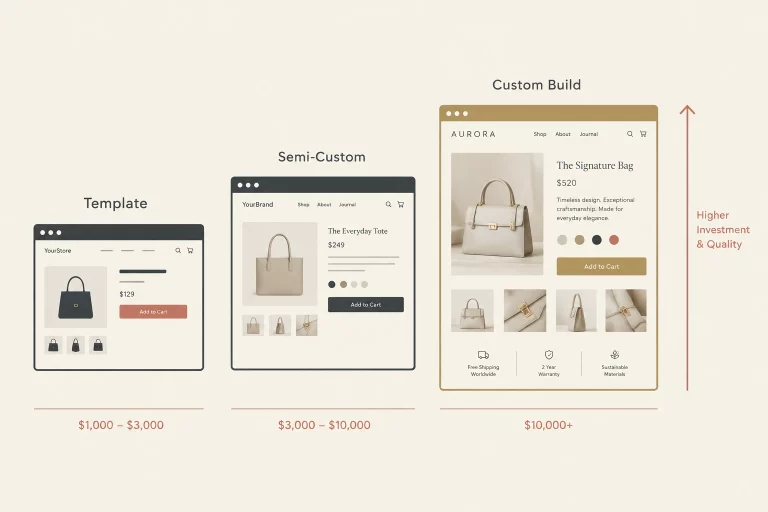
AED 8,000 to AED 15,000: A Shopify store using a premium theme, configured and customised rather than fully custom-built. Includes payment gateway integration, basic product catalogue setup, and standard mobile optimisation. Appropriate for businesses launching a first ecommerce store quickly with a manageable catalogue.
AED 15,000 to AED 40,000: A custom-built Shopify store or entry-level Magento build. Custom theme development, full UAE payment gateway integration including BNPL, Arabic RTL support, and third-party integrations such as logistics, ERP, and email. This is the appropriate range for serious consumer ecommerce in the UAE.
AED 40,000 to AED 100,000+: Complex Magento builds, multi-store setups, B2B ecommerce portals, or fully custom platforms. Enterprise-level requirements with custom pricing logic, deep integrations, and high-volume traffic architecture.
The most common mistake UAE businesses make is choosing a build at the lowest cost tier and then spending a similar amount again six months later to rebuild for performance or additional functionality. Scoping the project correctly from the start, including the payment gateways, the language requirements, and the third-party integrations you will need, is what prevents this.
What to Look for in an Ecommerce Web Design Agency in Dubai
Before you brief an agency, ask these five questions.
Have they built specifically for the UAE market? UAE-specific requirements, including payment gateway integrations, Arabic RTL, and mobile performance for UAE networks, are not generic web development skills. Ask for UAE ecommerce projects in their portfolio.
Do they handle both design and development in-house? Agencies that separate design and development across different teams or outsource one to a third party introduce communication failures that show up as alignment errors, delayed launches, and post-launch performance issues.
What is their process after launch? An ecommerce store does not end at launch. Ask about post-launch support, conversion rate optimisation, and how they handle technical issues once the site is live.
Do they understand ecommerce performance metrics? A good ecommerce agency should talk to you about conversion rate, average order value, cart abandonment rate, and page speed, not just design aesthetics.
Can they show you results, not just portfolios? Ask for specific outcomes from ecommerce projects, not just screenshots of stores, but what happened to the client’s revenue or conversion rate after launch.
Frequently Asked Questions — Ecommerce Web Design Dubai
How long does ecommerce website development in Dubai take?
A standard custom Shopify build takes four to eight weeks. A complex Magento or custom platform takes ten to sixteen weeks. Timeline depends on catalogue size, integration requirements, and content readiness from the client side.
Is Shopify available in the UAE?
Yes. Shopify operates fully in the UAE and supports all major UAE payment gateways including PayTabs, Network International, Tabby, and Tamara. Shopify stores can be set up with a UAE business account and configured for AED pricing.
Do I need an Arabic version of my ecommerce store?
Not necessarily from day one, but it is worth planning for it. The UAE has a large Arabic-speaking population, and Arabic-language ecommerce is growing. If your target customers include UAE nationals and residents who prefer Arabic, a bilingual store will meaningfully expand your addressable market.
What is the difference between ecommerce web design and ecommerce web development?
Ecommerce web design covers the visual layer, including layout, product page experience, checkout UX, and brand presentation. Ecommerce web development is the technical build, including the code, integrations, performance, and platform configuration. The best outcomes come from agencies that handle both under one roof.
Can Pixtar rebuild an underperforming ecommerce store?
Yes. We handle full ecommerce rebuilds, improving design, performance, and conversion rate while migrating existing products, customer data, and order history. We preserve your URL structure to protect existing search rankings.
Get an ecommerce web design quote from Pixtar →