
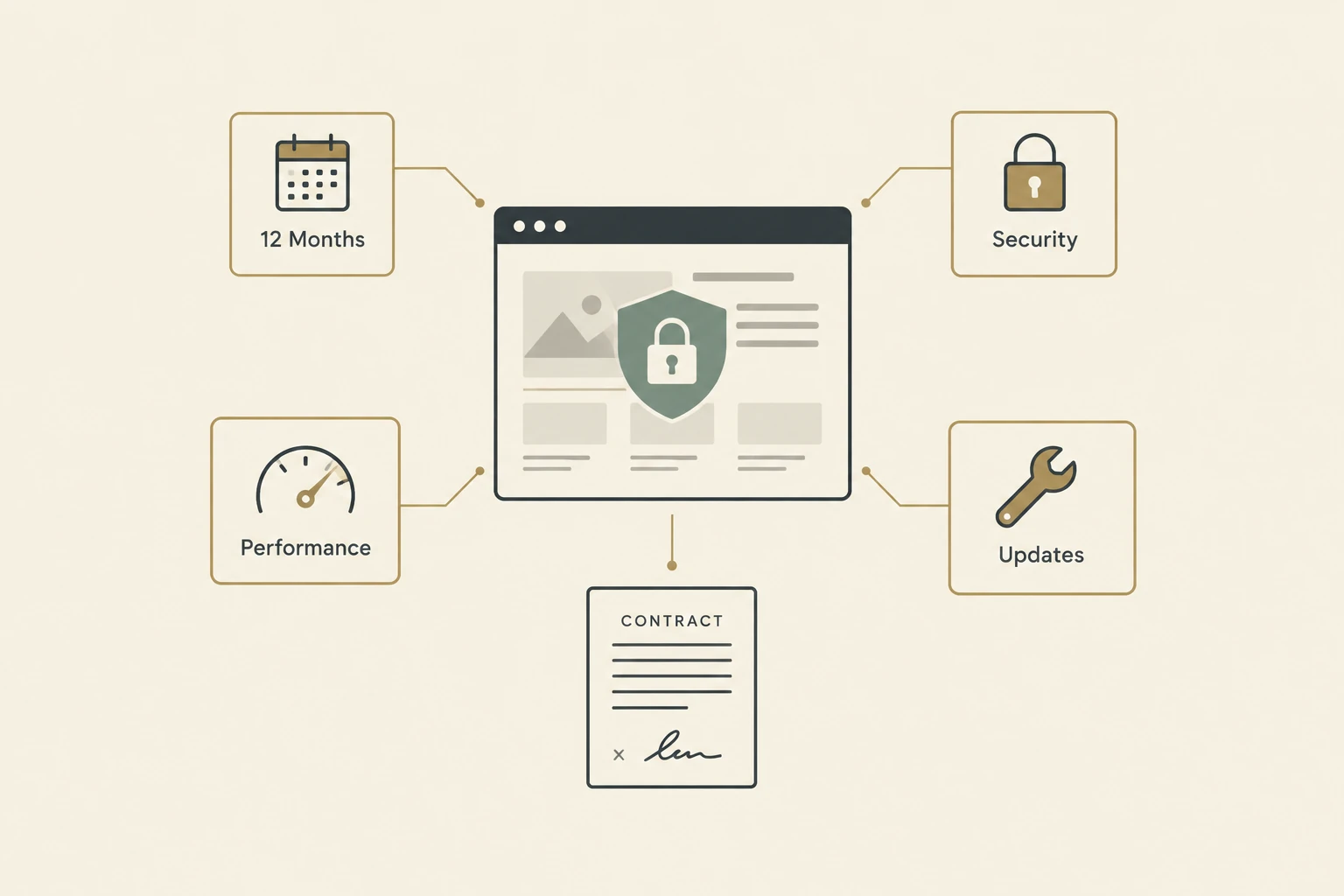
A website is not a one-time project. Once it is live, it needs ongoing attention: security patches, performance monitoring, software updates, content changes and the occasional fix when something breaks. In the UAE market, many businesses manage this through an AMC- an Annual Maintenance Contract with their web development agency.
The term is widely used in Dubai and across the GCC but rarely explained clearly. What does an AMC actually cover? What should it cost? What separates a well-structured contract from one that leaves a business exposed? This guide answers all of these questions before you sign anything.
In This Guide
1. What a Website AMC Actually Is
An Annual Maintenance Contract for a website is an agreement between a business and a web agency or developer, where the agency provides defined maintenance and support services for a fixed annual or monthly fee. The contract sets out what is covered, what the response times are, how many hours of work are included and what happens when something falls outside the agreed scope.
The AMC model is common in the UAE because it provides predictability for both sides. The business knows what it is paying for and what support it can expect. The agency knows what it is committing to deliver. Without this structure, maintenance tends to become reactive: things are fixed only when they break, which is nearly always at the worst possible moment and at a higher cost than scheduled upkeep would have been.
An AMC is different from a hosting contract. Hosting keeps the site running on a server. An AMC covers the ongoing work required to keep the site healthy, secure, performant and up to date once it is hosted. Many businesses in Dubai have both a hosting arrangement and a separate AMC with their development agency.
2. What a Good AMC Should Include
The specific scope varies between providers, but a well-structured website AMC in Dubai should cover the following as a minimum.
Security monitoring and updates
Websites face a constant stream of threats: vulnerability exploits, brute force login attempts, malware injection and plugin weaknesses. A good AMC includes regular security scans, prompt application of security patches and monitoring for unusual activity. For eCommerce websites handling payment data, this is not optional — it is a regulatory and reputational necessity.
CMS and plugin updates
WordPress, the platform most UAE business websites run on, releases regular core updates alongside updates to the themes and plugins the site depends on. Applying these promptly closes known security vulnerabilities. Leaving them unpatched is one of the most common reasons business websites are compromised. A good AMC handles this on a scheduled basis rather than leaving it to the client to manage.
Performance monitoring
Website speed affects search rankings, user experience and conversion rates. An AMC should include regular performance checks, identifying and addressing issues that cause page load times to degrade over time: unoptimised images, accumulated database bloat, plugin conflicts and hosting-level slowdowns.
Uptime monitoring
The AMC provider should monitor whether the site is online and respond promptly when it is not. A business that discovers its website has been down for six hours because a client mentioned it is in a different position from one whose agency identified the outage within minutes and resolved it before most visitors were affected.
Backup management
Regular, tested backups stored in a separate location from the live site are the foundation of any recovery plan. An AMC should specify how frequently backups are taken, where they are stored and how quickly the site can be restored from a backup in the event of a failure or security incident.
Minor content and technical updates
Most AMCs include a defined allocation of hours for minor updates: text changes, image swaps, adding a new team member to the about page, updating business hours or correcting a broken link. These small tasks accumulate quickly if they are handled as separate quoted jobs each time.
3. What an AMC Typically Does Not Cover
Understanding what falls outside an AMC is as important as knowing what is inside it. Common exclusions include the following.
New features or significant development work. Adding a new section to the website, building a new page template, integrating a new third-party tool or redesigning a section of the site are development tasks, not maintenance tasks. These are typically quoted and invoiced separately, even when the business has an active AMC.
Content creation. Writing new copy, producing photography or creating new design assets falls outside the scope of a maintenance contract. An AMC covers the technical health of the site and minor updates to existing content, not the creation of new content from scratch.
SEO strategy and marketing. Improving search rankings, running paid campaigns or producing blog content is marketing work, not maintenance work. Some agencies bundle basic technical SEO checks into an AMC, but strategy and execution are separate services.
Third-party platform failures. If a payment gateway, a booking system or a third-party integration goes down because of an issue on the provider’s side, that is outside the AMC scope. The agency can flag the issue and liaise with the provider, but the resolution depends on a third party, not the maintenance contractor.
Before signing: Ask for a clear written list of what is included and what is not. The most common source of dissatisfaction in AMC relationships is a mismatch between what the client expected to be covered and what the contract actually defines. A well-run agency will be specific about this before the contract is signed, not after a dispute arises.
4. What a Website AMC Costs in Dubai
AMC pricing in Dubai varies significantly based on the size and complexity of the website, the scope of services included and the agency’s positioning.
For a standard business website built on WordPress, a basic AMC covering security monitoring, updates, backups and a small hours allocation for minor changes typically ranges from AED 3,000 to AED 8,000 per year, or AED 250 to AED 700 per month.
For a more comprehensive AMC that includes performance optimisation, uptime monitoring, priority response times and a larger hours allocation for updates, expect to pay AED 8,000 to AED 20,000 per year depending on the site’s complexity and the agency’s service level commitments.
eCommerce websites require more intensive maintenance due to the volume of transactions, the security requirements around payment data and the frequency of catalogue and promotional updates. eCommerce AMC contracts typically start from AED 10,000 per year and increase with catalogue size and integration complexity.
The relevant comparison is not the cost of the AMC against doing nothing. It is the cost of the AMC against the cost of recovering from a security breach, a site outage during a peak trading period or an emergency development engagement at short notice. In almost every scenario, the AMC is the more cost-effective option.
5. Does Your Business Need a Website AMC?
Almost every business with a live website benefits from some form of structured maintenance. The question is less whether to have one and more what level of coverage is appropriate.
A basic AMC is appropriate for any business website that is actively used for lead generation, brand presentation or client communication. If the website going down or being compromised would cause real commercial or reputational damage, the cost of protection is justified.
A more comprehensive AMC is particularly important for the following situations.
eCommerce websites. A store that processes live transactions cannot afford downtime, security vulnerabilities or broken checkout flows. The maintenance requirement is higher and the cost of failures is direct and measurable. For a deeper understanding of what eCommerce websites require technically, read our guide on when an eCommerce site needs a rebuild.
Websites handling customer data. Any site that collects enquiry forms, booking requests or account registrations has a responsibility to protect that data. Regular security maintenance reduces the risk of a breach that could expose customer information and create regulatory and reputational consequences.
Businesses with no internal technical resource. If nobody in the business has the technical knowledge to respond to a site issue, having a contracted agency partner with defined response times is essential rather than optional. Without it, the business is dependent on finding and briefing a developer under pressure, which is rarely the fastest or most cost-effective way to resolve a problem.
Businesses where the website is the primary sales channel. If the website is where the majority of revenue or enquiries originates, treating maintenance as a discretionary cost is a false economy. The site is a business-critical asset and should be managed accordingly.
6. How to Choose the Right AMC Partner in Dubai
Confirm what is included in writing before signing. The scope, the hours allocation, the response times and the exclusions should all be specified clearly in the contract document. An agency that is reluctant to put these in writing is one to approach with caution.
Ask about response times specifically. What is the response time for a site that is completely down versus a site with a minor issue? Response time commitments vary widely between providers and matter significantly when something goes wrong at a critical moment. A 24-hour response time for a site outage is materially different from a four-hour response time.
Check whether backups are included and tested. Backups that exist but have never been tested are not reliable. Ask how frequently backups are taken, where they are stored and whether the agency tests restores as part of the AMC scope.
Understand what happens when work exceeds the included hours. Every AMC has a limit on included hours for minor updates. Ask specifically what happens when a month’s requests exceed that allocation: is additional work charged at an hourly rate, and if so at what rate? A clear answer upfront prevents billing disagreements later.
Assess whether the agency knows the site. The most effective AMC relationship is with the agency that built the site, because they understand its architecture, its dependencies and its known quirks. If that relationship is not available, any new AMC partner should conduct a technical audit of the site before the contract begins.
For a broader understanding of what website support involves beyond maintenance, read our piece on why a website is a business asset that needs active management and our guide on how website performance affects business outcomes.
Frequently Asked Questions
What does AMC stand for in website maintenance?
AMC stands for Annual Maintenance Contract. In the context of websites in Dubai and the UAE, it refers to a structured agreement between a business and a web agency that defines what maintenance and support services will be provided over a twelve-month period, at a fixed annual or monthly fee. The term is widely used in the UAE technology and services market and covers everything from security updates and backups to uptime monitoring and minor content changes.
How much does a website AMC cost in Dubai?
A basic website AMC in Dubai for a standard business website typically costs between AED 3,000 and AED 8,000 per year. A more comprehensive AMC with priority response times, performance monitoring and a larger hours allocation ranges from AED 8,000 to AED 20,000 per year. eCommerce website AMCs start from AED 10,000 per year and increase with site complexity. The cost should be evaluated against the commercial risk of a site outage or security incident, not against doing nothing.
What is the difference between a website AMC and web hosting?
Web hosting keeps a site running on a server. It covers server infrastructure, uptime at the hosting level and storage. A website AMC covers the ongoing technical work required to keep the site healthy once it is hosted: security updates, plugin maintenance, performance monitoring, backups and minor content changes. A business typically needs both: a hosting arrangement and a separate AMC for the site itself.
Is a website AMC necessary for a small business in Dubai?
For any business where the website is actively used for lead generation, brand presentation or client communication, some form of structured maintenance is advisable. Small businesses with simple brochure sites on well-managed platforms may be able to handle basic maintenance internally. However, any business without internal technical resource, or whose site collects customer data or processes transactions, benefits significantly from a contracted maintenance partner with defined response times.
What should I check before signing a website AMC in Dubai?
Confirm what is included and excluded in writing, what the response times are for different severity levels, how frequently backups are taken and tested, what happens when work exceeds the included hours, and whether the agency is familiar with the site’s technical architecture. The contract should specify all of these clearly. Any ambiguity in the scope before signing tends to become a source of friction during the contract period.
Does Pixtar offer website AMC services in Dubai?
Yes. Pixtar provides website maintenance and support services for businesses across Dubai and the UAE, including ongoing security monitoring, updates, performance checks and technical support. Maintenance agreements are structured to match the size and complexity of the site. You can explore our website maintenance services or get in touch to discuss the right level of coverage for your business.
Looking for a Website AMC in Dubai?
Pixtar provides structured website maintenance and support contracts for businesses across Dubai and the UAE. Security monitoring, updates, backups, performance checks and technical support — with clear response times and transparent pricing.
→ Explore Our Website Maintenance Services
Related reading:
What Website Maintenance Should Include
Why Website Loading Experience Shapes Brand Perception
eCommerce Redesign in Dubai: Refresh vs Rebuild
Why Every Business Needs a Website
How Much Does an eCommerce Website Cost in Dubai?
Further reading:
Google web.dev: Core Web Vitals and Performance
WordPress: Keeping Your Site Updated and Secure