
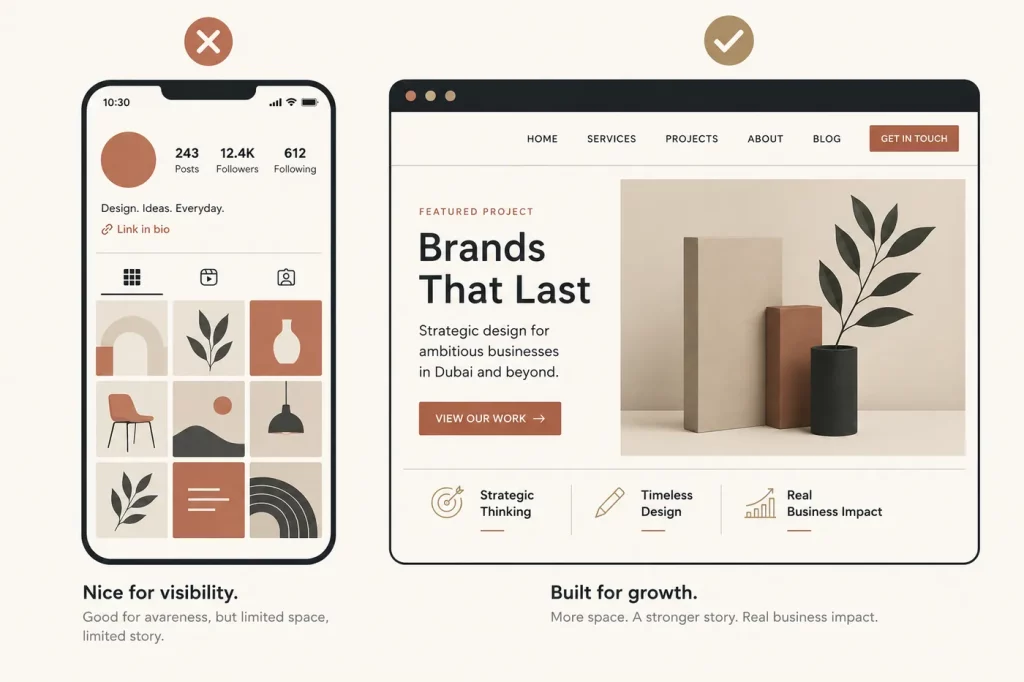
Why an Instagram Grid Isn’t Enough to Win Commercial Projects
Walk into a pitch meeting with a property developer or a commercial fit-out client in Dubai, and the first thing they’ll do after the meeting is search your studio’s name. If what comes back is an Instagram profile with a shrinking grid of tagged photos and a link-in-bio service, you’ve already lost ground to the studio whose name returns a proper website with a real portfolio, a clear service breakdown, and case studies they can actually read at their desk. For residential clients, Instagram can carry a lot of the relationship. For commercial and developer clients — the ones evaluating three or four studios against a brief, a budget, and a timeline — a social feed reads as unfinished. A dedicated portfolio website is what signals that your studio operates at the scale the project needs.
What a Property Developer or Fit-Out Client Is Actually Looking For
Commercial and developer clients in Dubai and Abu Dhabi are rarely making a one-off decision. They’re often evaluating a studio for a relationship that could span several projects — a residential tower’s show apartments, a retail fit-out, a hospitality refresh. Before they’ll pick up the phone, they want to see three things a website answers far better than social media ever can:
- Proof of scale. Have you handled projects of comparable size and complexity? A portfolio website lets you organize past work by project type — residential, retail, hospitality, office fit-out — so a developer can find the comparable project in under a minute instead of scrolling a feed.
- Process clarity. Commercial clients want to know how a project actually runs: site visits, concept development, material sourcing, contractor coordination, handover. A website can lay this out as a clear step-by-step process page, which reduces the number of “how does this work” questions before a client ever contacts you.
- Credibility signals. Client testimonials, before-and-after project photography, and a clean “About” page that explains who’s behind the studio all do more to build trust with a corporate decision-maker than a well-lit Instagram Reel.
What Actually Belongs on an Interior Design Studio’s Website
A strong portfolio website for a Dubai-based interior design or fit-out studio typically includes:
- A project gallery organized by category — not a chronological dump, but sortable by residential, commercial, hospitality, or retail, so a visitor with a specific need finds relevant work immediately.
- Individual project pages (microsites) for flagship projects — a dedicated page per project with a narrative of the brief, the design approach, material choices, and a full photo set. This is also where SEO value compounds: each project page can rank for its own set of local, project-type search terms over time.
- A services page that separates what you actually offer — concept design, space planning, fit-out project management, furniture sourcing — rather than one paragraph that tries to cover everything at once.
- A process/timeline page that sets expectations: how long a typical residential project takes versus a commercial fit-out, what the client needs to provide at each stage, and how revisions are handled.
- Client testimonials and, where possible, named case studies — a developer is more likely to trust a named commercial client reference than an anonymous quote.
How Long Does a Studio Website Like This Take to Build?
For a Dubai-based studio, a portfolio website with 8-12 project pages, a services breakdown, and a process page typically takes 4-8 weeks from kickoff to launch, depending on how much existing photography and project documentation is ready to use. The biggest variable isn’t design or development time — it’s how quickly a studio can pull together high-resolution project photography and a short written brief for each featured project. Studios that already have professional photography from past projects move faster; studios that need to schedule new shoots should plan for that lead time separately.
What Drives the Cost Up or Down
Pricing for a studio portfolio website in Dubai is driven mainly by three factors: how many individual project pages need custom layouts (a flagship project with a rich photo essay costs more to build than a simple grid entry), whether the site needs bilingual English/Arabic content for a broader GCC audience, and whether it needs to integrate with anything beyond the website itself — a booking/consultation form, a newsletter, or a CRM for lead capture. A studio just starting to formalize its digital presence can launch a focused, well-built site without every one of these features and add them in a second phase once the site is generating enquiries.
Portfolio Website vs. Instagram and Behance: What Each Actually Does
These aren’t competing options — they serve different jobs. Instagram is where you build ongoing visibility and show work-in-progress; Behance is useful for design-community visibility and awards submissions. Neither is built to convert a commercial enquiry into a signed contract. A prospective client can’t easily compare three past projects side-by-side on Instagram, can’t read your process, and can’t be sure the account is actively managed by the studio versus outdated. A website is the one asset you fully own and control, that’s built specifically to answer a serious buyer’s questions and move them toward a consultation — while your Instagram and Behance profiles continue doing what they’re good at upstream.
Common Objections Studios Raise Before Investing in a Website
“Most of our work comes from referrals — do we still need this?” Referred clients still check you out online before calling. A referral gets you the introduction; the website is what confirms the decision. Without one, a strong referral can quietly lose confidence at the research stage.
“We don’t have enough finished projects to fill a full site yet.” A focused site with 5-6 strong projects, presented properly, outperforms a sprawling site padded with weaker work. The site can grow project-by-project as new work completes — it doesn’t need to launch complete.
“Will this replace what our showroom or physical portfolio does?” No — it extends it. A physical portfolio only works for people already in the room. A website works for the developer doing initial research at 11pm, long before a meeting is ever scheduled.
Deliverables and What You Own After Launch
A studio commissioning a portfolio website should expect to own the final design files, the content management access to add new projects without needing a developer for every update, and full rights to the photography and copy used across the site (subject to whatever agreement is in place with the original project photographer). Being able to add a new completed project yourself — rather than requesting a developer change every time — is what keeps a portfolio site current instead of becoming another out-of-date asset within a year.
Getting Started
For an interior design studio or fit-out company operating across Dubai, Abu Dhabi, or Sharjah, the fastest way to start is with an audit of what already exists: current photography, past project write-ups, and whatever site or landing page is live today, if any. From there, a realistic project list and timeline can be scoped in a single consultation — no need to have every asset ready before that conversation happens.