
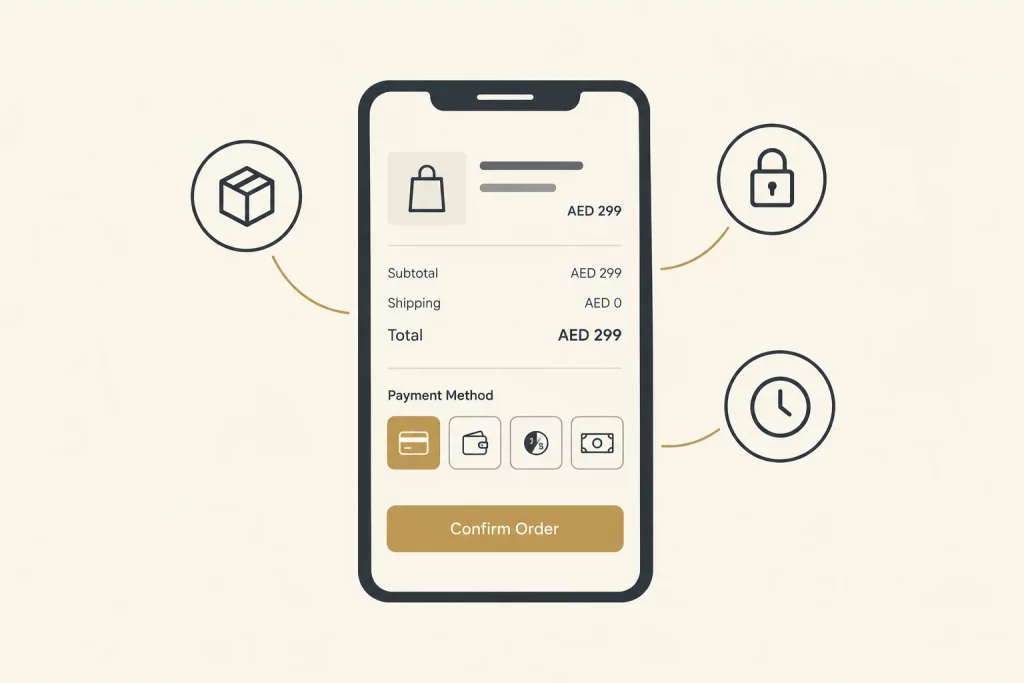
Most premium online stores in the UAE do not lose sales on the homepage or the product page. They lose them at checkout, after the customer has already decided to buy. A missing payment option, a slow form or a confusing delivery step is often all it takes for a full basket to be abandoned.
This guide covers how to build an ecommerce checkout for the UAE market: which payment methods to offer, how to handle instalments and cash on delivery, and the design choices that remove friction without making the store feel cheap.
Table of Contents
- Why Checkout Is Where Premium Stores Lose the Sale
- Payment Gateway vs Payment Method
- Cards and Digital Wallets
- Instalments and Buy Now Pay Later
- Cash on Delivery Without the Headaches
- Checkout Design That Reduces Drop-Off
- Mobile and Arabic Checkout
- Trust, Security and Delivery Clarity
- Pre-Launch Checkout Checklist
- Frequently Asked Questions
1. Why Checkout Is Where Premium Stores Lose the Sale
By the time a shopper reaches checkout they have already accepted your brand, your product and your price. What is left is a practical question: can I pay the way I want, and do I trust this store with my details?
Premium stores often make this step harder than it needs to be. Forced account creation, long forms, hidden delivery costs and a narrow set of payment options all add friction at the worst possible moment. Because the shopper was already convinced, every extra step feels like a reason to leave.
This is why checkout deserves the same attention as your homepage and product pages. It is the part of your ecommerce store that directly converts interest into revenue.
2. Payment Gateway vs Payment Method
These two terms get mixed up, and the difference affects how you plan your setup.
Payment gateway
The gateway is the infrastructure that processes the transaction behind the scenes. Options commonly used by UAE merchants include Stripe, Telr, PayTabs, Network International, Amazon Payment Services, Checkout.com and Tap Payments. Which one suits you depends on your volume, your platform, your onboarding timeline and whether you sell outside the UAE.
Payment method
The method is what the customer sees and chooses at checkout, such as a card, Apple Pay, an instalment provider or cash on delivery. One gateway can support several methods, and some methods such as instalment plans are added through their own integration.
Plan the methods first, then choose a gateway that supports them. Doing it the other way round is how stores end up missing an option their customers expect.
3. Cards and Digital Wallets
Visa and Mastercard are the baseline for any UAE store. Beyond cards, digital wallets are worth prioritising because they turn a long form into a single tap.
Apple Pay is widely supported across UAE gateways and is especially useful on mobile, where typing card numbers is the biggest source of drop-off. Where your gateway supports Samsung Pay or Google Pay, adding them covers customers on other devices.
Whichever wallets you offer, place them at the top of the checkout so a returning or mobile shopper can finish in seconds, and keep the standard card form available directly below for everyone else.
4. Instalments and Buy Now Pay Later
Instalment payments are now a normal expectation for higher-value purchases in the UAE, particularly in fashion, electronics, beauty and home. Two providers are widely used by UAE retailers: Tabby and Tamara.
Terms differ by provider and by merchant. For example, major UAE retailers list instalment plans of up to six monthly payments with Tabby and up to four monthly payments with Tamara, subject to each provider’s own terms. Your own options depend on the agreement you set up with the provider.
How to present instalments well
- Show the split early. Display the instalment amount on the product page and in the cart, not only at the final payment step. Seeing a smaller monthly figure early supports the decision to add to basket.
- Be clear about the terms. Show the number of payments and link to the provider’s conditions so nothing feels hidden.
- Use the providers’ official badges and messaging components. These are usually available through plugins or the provider’s developer tools.
- Test the redirect. Customers are often sent to the provider’s own page to complete approval, so check that the journey back to your order confirmation works on mobile.
Instalment providers charge merchants a fee, which varies by agreement. Confirm the fee structure directly with each provider and factor it into your pricing before you switch it on.
5. Cash on Delivery Without the Headaches
Cash on delivery remains familiar to many UAE shoppers, especially first-time buyers who are not yet comfortable paying a new store online. Removing it entirely can cost you those customers. Keeping it without controls can cost you in failed deliveries and returns.
Practical ways to manage COD
- Set an order value limit. Large UAE retailers apply caps to cash on delivery, with figures in the thousands of dirhams that vary by retailer. Choose a limit that matches your risk.
- Limit it by product or category. Some retailers offer COD only for specific products. High-value or easily resold items are common candidates for exclusion.
- Offer card on delivery as well. This gives customers a no-cash option at the door and reduces cash handling for your courier.
- Confirm the order first. A quick SMS or WhatsApp confirmation before dispatch reduces failed deliveries.
- Consider a small COD fee or an incentive for prepayment. Either can gently move customers toward paying online, as long as the fee is shown clearly before the final step.
- Make sure your courier supports it. Cash collection and remittance depend on your logistics partner, so confirm how and when funds are settled.
6. Checkout Design That Reduces Drop-Off
Allow guest checkout
Forcing account creation before payment is one of the most common causes of abandoned baskets. Offer guest checkout and invite the customer to save their details after the order is placed.
Keep the form short
Ask only for what you need to deliver and contact the customer. Use address autofill where possible and make sure phone number fields accept UAE formats without errors.
Show the full cost early
Surprise delivery fees and VAT at the last step are a major reason for drop-off. Show shipping and the total in the cart, and be clear about whether prices include VAT.
Use clear progress and a single focus
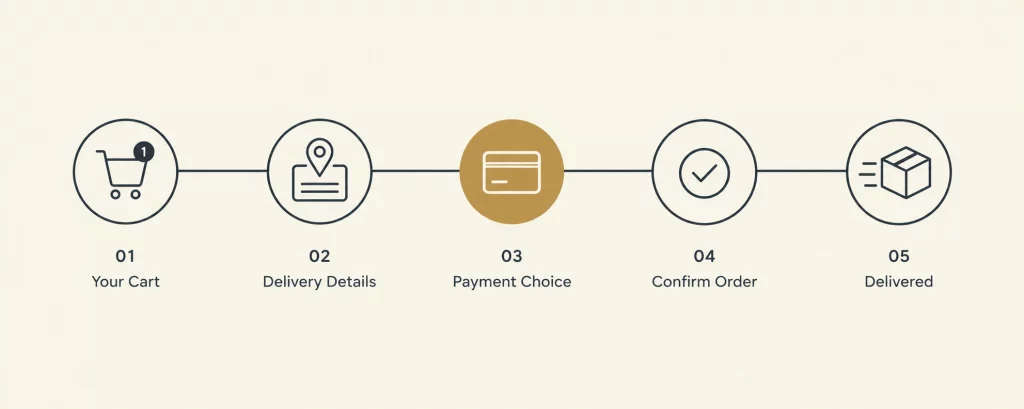
A simple progress indicator and a layout with no distracting navigation keep attention on completing the order. Remove the main menu and promotional banners from the payment step.
Write helpful error messages
If a card fails or a field is wrong, say exactly what happened and how to fix it. A vague error is often where a customer gives up.
Keep it on brand
Checkout should feel like the same store as the rest of the site. Typography, colour and tone of voice should carry through, which is why checkout design works best when it follows a documented brand identity rather than a default platform template.
7. Mobile and Arabic Checkout
Most shoppers in the UAE browse and buy on their phones, so test your checkout on a real device rather than only on a desktop browser. Check that buttons are easy to tap, the keyboard type matches each field and wallet buttons load quickly.
If your store serves Arabic speakers, the Arabic checkout needs to be a proper right-to-left layout, not a mirrored afterthought. Form labels, error messages, order summaries and confirmation emails should all work in both languages. This is a core part of custom website development for the UAE market and is easy to miss when a store is built in English first.
8. Trust, Security and Delivery Clarity
- Visible security cues. Show recognised payment logos and a clear secure connection indicator near the payment fields.
- Clear delivery information. State delivery windows and costs before payment, not after.
- Visible return and refund policy. A short summary near the order button reduces hesitation.
- Reachable support. A WhatsApp number or chat link on the checkout page gives anxious customers a way to ask a question instead of leaving.
- Prompt confirmation. Send an order confirmation by email straight after payment, and by SMS or WhatsApp if you can.

9. Pre-Launch Checkout Checklist
- Cards, Apple Pay and at least one instalment option are tested end to end.
- Cash on delivery rules (limits, product restrictions, confirmation step) are set and tested.
- Guest checkout works and the form is as short as it can be.
- Delivery cost, VAT and the total are visible before the final step.
- The full flow has been tested on at least one iPhone and one Android phone.
- The Arabic version is checked by a native reader.
- Failed payment, cancelled payment and returning from an instalment provider all show clear messages.
- Order confirmation emails and messages arrive quickly and look on brand.
- Analytics track each checkout step so you can see where customers drop off.
Frequently Asked Questions
Which payment methods should a UAE online store offer?
At minimum, Visa and Mastercard plus Apple Pay. For higher-value products, add at least one instalment provider. Cash on delivery is worth considering if your customers are new to your store or your category, with sensible limits in place.
Is cash on delivery still worth offering?
For many stores it is, particularly when you are building trust with new customers. The key is to control it with order limits, confirmation steps and a courier that handles cash collection reliably.
What is the difference between Tabby and Tamara?
Both are instalment providers used by UAE retailers, and terms such as the maximum number of payments differ between them and between merchants. Many stores offer both so customers can choose. Check each provider’s current merchant terms before deciding.
Which payment gateway is best for a UAE store?
There is no single best option. Stripe, Telr, PayTabs, Network International, Amazon Payment Services, Checkout.com and Tap Payments are all used in the region. Choose based on your platform, expected volume, onboarding speed and the payment methods you need to support.
How do I reduce checkout abandonment?
Offer guest checkout, keep the form short, show the full cost early, support wallets and instalments and test everything on mobile. Then track each step so you can see exactly where customers leave.
Can Pixtar build or improve our checkout?
Yes. Pixtar designs and builds online stores under one team, from brand identity to storefront to checkout, so the experience feels consistent from the first click to the confirmation page.
Losing Sales at Checkout?
Pixtar builds ecommerce stores for UAE brands with checkout flows designed around local payment habits, so customers who are ready to buy can complete the order without friction. Tell us about your store and we will review your current checkout with you.
→ Explore Ecommerce Web Development at Pixtar
Related reading:
How to Build a Brand Identity
Branding, Web Design and eCommerce Services in Dubai
Graphic Design Agency Dubai and Packaging Design
Branding Services and Brand Strategy in Dubai