

The UAE has never been short of ambition. Every year, thousands of new businesses register across Dubai and Abu Dhabi- founders with real ideas, genuine conviction and genuine funding. And yet, a striking number of them make the same startup branding mistake, usually within the first few weeks of deciding to launch.
They design a logo before they know who they are building for.
It sounds like a small thing. It is not. And by the time most founders realise it, they have already spent money, printed materials, built a website and accumulated a brand that quietly works against them.
Table of Contents
1. The Mistake That Looks Like Progress
There is something psychologically satisfying about seeing your brand name in a typeface you have chosen, with colours that feel right, on a mockup of a business card. It feels like the business is becoming real.
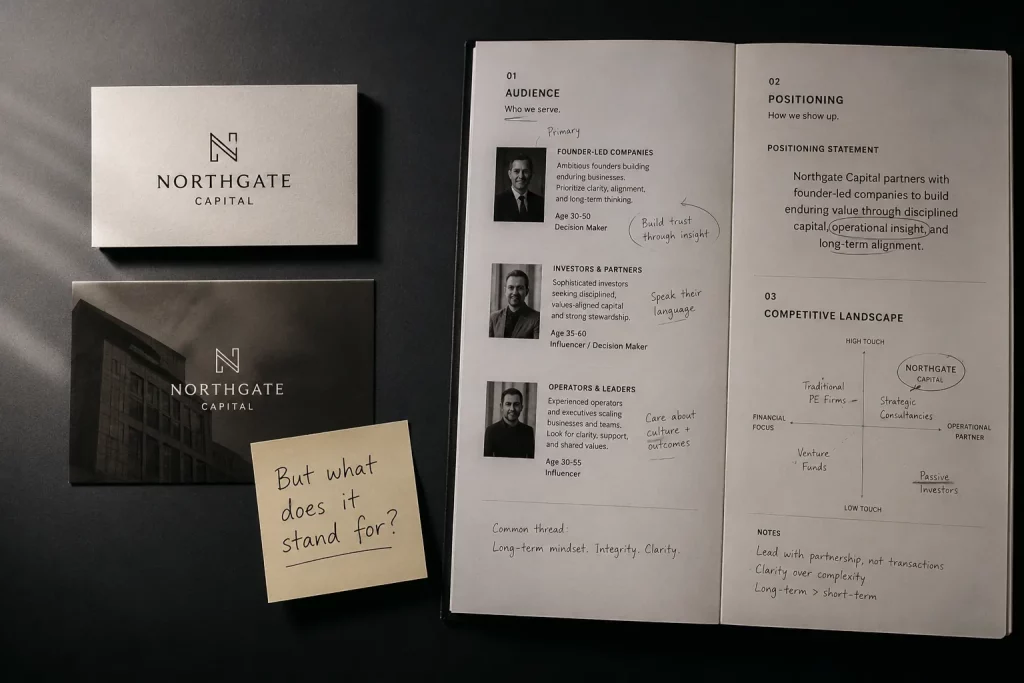
But a logo is not a brand. It is the output of a brand. When you design the output before building the foundation, you end up with an identity that has no strategic logic behind it, no positioning it was built to express, no audience it was built to speak to, no differentiation it was designed to communicate.
This matters in any market. In Dubai, it is particularly costly. Dubai is a city where premium positioning is the default expectation. If your startup branding does not immediately communicate quality, clarity, and credibility, the people you are trying to reach simply move on. There is always another option. The brands that win here are the ones that feel intentional from the very first interaction — and that feeling is not accidental. It is built deliberately, through strategy.
The core problem: A logo designed before strategy has no foundation. It may look good in isolation — but it cannot do the job of communicating who you are, who you are for, and why you are different. That work has to happen first.

2. The Five Things Dubai Startups Skip (and Regret)
1. Audience Definition That Goes Beyond Demographics
Knowing your target audience is “UAE-based HNIs aged 35–55” is the beginning of a brief, not a strategy. What are they already using? What do they find unsatisfying about it? What would make them switch, and what would make them stay? The sharper your audience understanding, the more precisely your brand can speak and the less work your marketing has to do later.
2. Positioning That Actually Holds Up
“Premium quality” is not positioning. Neither is “exceptional service” or “innovative approach.” These are claims that every brand makes and no brand proves. Real positioning is specific, ownable, and sometimes slightly uncomfortable because it means ruling something out. If your brand is for everyone, it will connect with no one.
3. A Name Built for the Market It Is Entering
The UAE operates across Arabic and English. Names that work beautifully in one language can be tonally wrong, difficult to pronounce, or unintentionally suggestive in another. This is a technical and cultural challenge that requires thought — not just a naming brainstorm conducted entirely in one language by a team based in one country.
4. A Visual Identity System, Not Just a Logo
A logo on its own cannot do the work of an identity. Fonts, colour palettes, graphic elements, photography direction, motion principles: these are the components that allow a brand to show up consistently across a website, a social feed, a pitch deck, a physical space, and a packaging design. Without a system, every new application becomes a creative decision from scratch — and the result is a brand that looks inconsistent and feels unfinished.
5. A Tone of Voice That Is Actually Written Down
How your brand speaks is as important as how it looks. But most UAE startups treat this as an afterthought — something handled in the moment when someone sits down to write a caption or a proposal. The result is a brand that sounds different depending on who is writing and what they had for breakfast. Voice should be documented, exemplified, and treated as a brand asset with the same rigour as the visual identity.
| What Gets Skipped | What It Costs You |
|---|---|
| Audience definition | Marketing spend that reaches the wrong people |
| Positioning | A brand that blends in rather than stands out |
| Naming strategy | A name that does not travel well across Arabic and English |
| Identity system | Inconsistency across every new touchpoint |
| Tone of voice | A brand that sounds different every time someone writes for it |
3. Why the UAE Market Makes This More Urgent
Startups in London or New York often have the luxury of iterating quietly in a market that is large enough to absorb early inconsistency. The UAE is different.
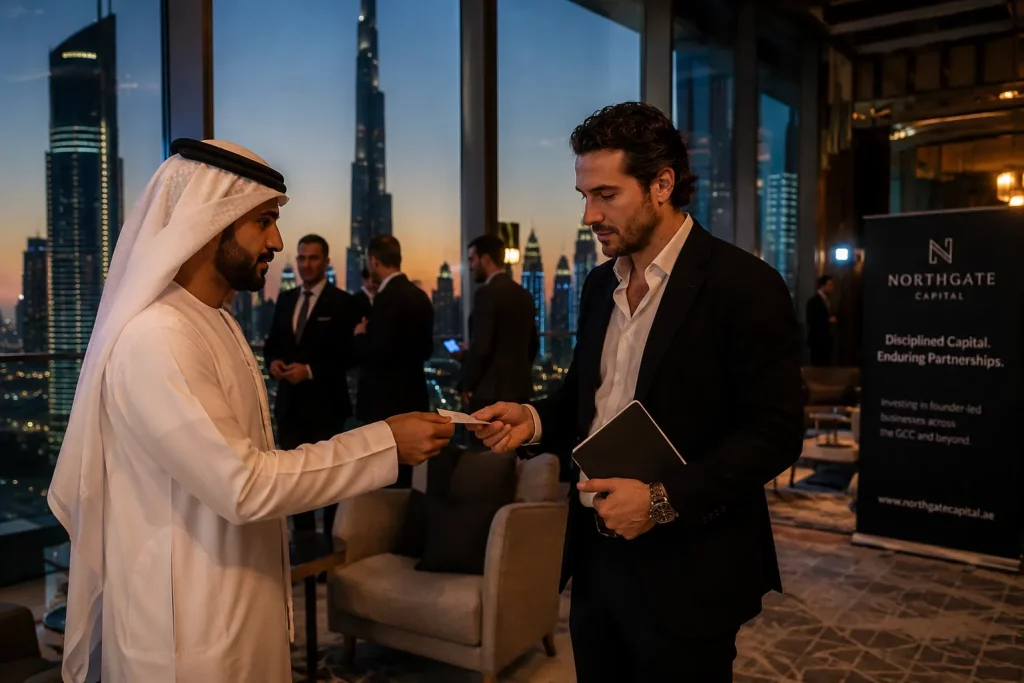
The networks here are smaller and more concentrated. A poorly positioned brand in Dubai does not disappear into the noise- it circulates in the same rooms as the people you need to impress. Reputation moves fast. First impressions stick.
There is also the question of internationalisation. Most UAE founders are not building only for the local market. The vision typically involves expanding into Saudi Arabia, establishing credibility with European investors, or positioning for a global category. A brand built hastily for the domestic market will struggle to make that transition cleanly. A brand built with that eventual expansion in mind is already ahead.
The Dubai reality: Premium positioning is the default expectation here, not the exception. In a market where your audience encounters world-class brands daily, inconsistency is not charming — it is disqualifying.
4. What Smart Founders Do Instead
The founders who get this right share one characteristic: they treat brand strategy as an investment in sales efficiency, not as a cost on the way to launching.
They start with the questions that feel uncomfortable: Who exactly are we for? What do we believe that our competitors do not? What would our best client say about us to a friend? What does winning look like in three years- and does our brand today point in that direction?
They bring in strategic thinking early, before any design work begins and they use that thinking to create a brief that actually gives their creative team something to build against. The design that follows is not arbitrary. It is built to express something specific.
And when the logo, the identity, and the website are finished, everything points in the same direction. The visual and the verbal are consistent with each other and with the strategy. There is no gap between what the brand promises and what the business delivers.
That kind of coherence is not expensive to build. It is expensive not to build.
Frequently Asked Questions
When should a Dubai startup start thinking about branding?
Before launch, ideally before any design work begins. Startup branding decisions made before you understand your positioning, audience, and competitive landscape usually need to be redone within 12 to 18 months. The most efficient path is strategy first, identity second.
How much should a Dubai startup budget for branding?
This depends on the depth of the engagement and the complexity of the brand. Startup branding in Dubai typically starts from AED 12,000–15,000 for a solid foundational identity. Full brand development — including strategy, naming, identity, and guidelines- can range from AED 25,000 to AED 60,000 and above. Read our branding cost guide for Dubai to understand what is included at different investment levels.
Can I use a template or AI-generated logo to start?
You can — but understand what you are trading. A templated logo gives you a visual placeholder. It does not give you a brand. If your business is pre-revenue and you are genuinely testing an idea, a placeholder may be fine. But the moment you are presenting to investors, pitching premium clients, or entering a competitive market, a template will work against you. Read more on why custom logos matter.
Do I need brand guidelines as a startup?
Yes! and earlier than most startups think. Guidelines do not have to be a 100-page document. Even a concise brand guide covering your logo usage, colour palette, typography, and tone of voice rules will significantly improve the consistency of how your brand is applied across every touchpoint.
How do I know if my startup’s branding is working?
A few practical signals: Are people remembering your brand name after a first meeting? Does your team describe the company consistently when asked what you do? Are inbound enquiries coming from the type of client you actually want to work with? Branding is working when it quietly does the job of filtering and attracting the right people- without you having to explain yourself every time.
What is the biggest startup branding mistake Dubai founders make?
Building a visual identity before completing the strategy. The second biggest is creating a brand that is indistinguishable from competitors, which usually happens because no one asked the hard positioning question early enough. Both are fixable, but both are easier to avoid than to reverse.
Should a startup in Dubai hire a local branding agency?
A local agency brings market knowledge that is genuinely valuable for startup branding in Dubai, understanding of Arabic and English brand contexts, cultural nuances, and the specific aesthetic expectations of Dubai’s premium market. That said, the most important criterion is strategic capability first, local knowledge second. Look for an agency that asks questions about your business before it shows you mood boards.
Explore related thinking:
→ How to Build a Brand Identity
→ Brand Strategy — What It Is and Why It Matters
→ How Branding Services in Dubai Can Help Your Business
→ Custom Logo Design: Why Templates Fall Short
Startup Branding in Dubai- Done Right, From Day One
Strategy before design. Positioning before aesthetics. If you are launching in Dubai and want a brand that actually works in this market, let us help you build it properly- the first time.