
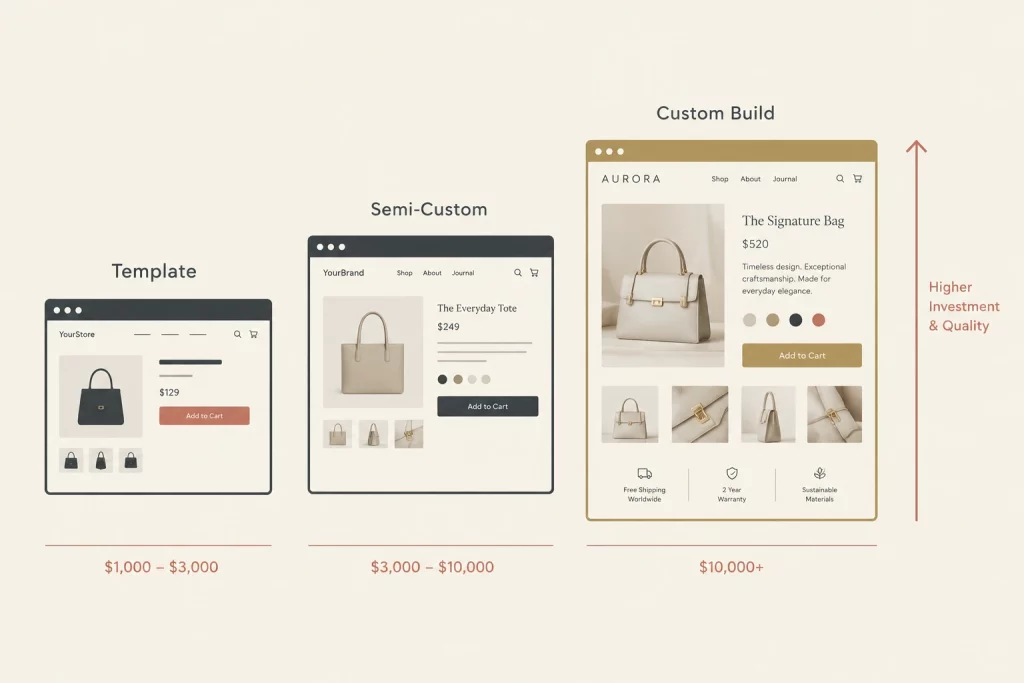
The honest answer is that it depends: but that is not useful without understanding what it depends on. eCommerce website development in Dubai ranges from AED 5,000 for a basic template-based store to AED 150,000 and above for a fully custom build with complex integrations. The gap is not arbitrary. Each price point reflects a fundamentally different scope, process and outcome.
This guide breaks down what drives eCommerce website costs in Dubai, what to expect at each investment level and what to ask any agency before committing to a project.
In This Guide
1. What the Price Tiers Actually Include
AED 5,000 to AED 15,000: Template-based builds
At this level, work is done within a pre-built Shopify or WooCommerce theme. The store can be launched quickly and will cover the basics: product pages, a cart, a checkout and a basic mobile layout. What it will not cover is a design built around your brand, custom functionality, complex product logic or serious performance optimisation. Appropriate for businesses testing an idea before committing, or for very small catalogues with a simple purchase journey.
AED 15,000 to AED 45,000: Semi-custom builds
A theme or starter template is used as a foundation but customised meaningfully around the brand, the catalogue structure and the user journey. The checkout, the product pages and the category navigation are tailored rather than default. Integrations with local payment gateways, basic CRM or inventory tools are included. This is the most common range for established small-to-mid-size eCommerce businesses in Dubai launching or relaunching a store.
AED 45,000 to AED 150,000+: Custom builds
Built from the ground up or on a headless architecture. Every element: the design system, the catalogue logic, the checkout flow, the post-purchase experience and the integrations: is built specifically for the business. Appropriate for brands with complex product catalogues, subscription or loyalty mechanics, multi-currency or multi-language requirements, B2B ordering workflows or platform migrations from legacy systems. This is where Pixtar’s eCommerce development work typically sits for premium and growth-stage brands.
2. The Six Things That Drive eCommerce Website Cost
Catalogue size and complexity
A store with 20 SKUs in one category is a fundamentally different build from one with 2,000 SKUs across multiple categories, variants, bundles and size guides. The more complex the catalogue logic: filtering, sorting, search, variant display: the more development time it requires.
Design scope
A custom design built from a brand identity system takes longer than applying a brand’s colours to a template. For premium eCommerce brands in Dubai, the design is often a significant portion of the total cost: and worth it, because the product page is the primary commercial interaction between the brand and the buyer.
Checkout and payment integrations
A standard Shopify checkout with international cards is fast to implement. Adding Tabby, Tamara, Telr, PayTabs, cash on delivery logic and Arabic RTL checkout support adds meaningful development time. These integrations are not optional for serious UAE eCommerce: they are what converts UAE buyers who expect them as standard. See our guide on choosing the right eCommerce platform for a UAE business for more on this.
Third-party integrations
Connecting an eCommerce store to an existing ERP, a warehouse management system, a loyalty programme, a CRM or a fulfilment partner adds significant scope. Each integration requires custom API work, testing and ongoing maintenance. Confirm exactly which integrations are required before any project is scoped.
Bilingual functionality
Arabic and English is not a toggle: it is a development project. RTL layout, separate SEO metadata, translated content management workflows and currency localisation all need to be built and tested properly. Stores that handle this well convert meaningfully better with Arabic-speaking UAE buyers than those that treat it as an afterthought.
Post-launch support scope
Many agencies quote for the build but do not include post-launch support, bug fixing or performance monitoring. Confirm what is covered in the weeks after go-live, and what the arrangement is for ongoing maintenance and updates.
3. UAE-Specific Cost Factors Most Agencies Do Not Mention Upfront
Local payment gateway setup fees. Tabby, Tamara, Telr and PayTabs all have onboarding requirements and merchant account setup processes that add time before launch. Factor this into the project timeline, not just the budget.
Cash on delivery logic. COD remains a significant proportion of UAE eCommerce orders, particularly for first-time buyers. Building COD as a payment option with proper order management and confirmation workflows is a specific development task, not a built-in feature on most platforms.
VAT compliance. UAE VAT registration requirements affect how the store displays prices, calculates tax at checkout and issues compliant receipts. A store launched without this properly configured creates accounting and compliance problems that are expensive to fix after the fact.
Arabic SEO. If Arabic content is part of the plan, Arabic metadata, Arabic URL structures and correct hreflang pairing between the English and Arabic versions of the store need to be built into the development from day one. Retrofitting these after launch costs more than doing them properly upfront.
A note on quotes: A low quote from an agency that has not worked on UAE eCommerce before will rarely include these items. They are not trying to mislead: they simply have not encountered them. Ask any agency directly: have you built a store with Tabby or Tamara integration, Arabic RTL checkout and cash on delivery support? If the answer is uncertain, factor in additional time and cost for that learning curve.
4. Ongoing Costs After Launch
The build cost is one investment. The cost of running an eCommerce store is a separate, ongoing one. These are the recurring items to budget for after a store goes live.
- Platform fees: Shopify plans range from USD 39 to USD 399 per month. Enterprise plans (Shopify Plus) start from USD 2,500 per month. WooCommerce hosting costs vary. Magento Commerce licensing is an enterprise-level cost.
- Payment gateway transaction fees: Most UAE gateways charge a percentage per transaction plus a fixed fee. These compound significantly at volume.
- Website maintenance: Security updates, platform version upgrades, bug fixes and performance monitoring. Budget AED 900 to AED 3,500 per month depending on complexity. Our website maintenance service covers this for eCommerce stores.
- Content updates: New product uploads, seasonal promotions, banner updates and catalogue management. Either in-house time or agency retainer cost.
- Performance monitoring and optimisation: A well-built store requires periodic performance audits as the catalogue grows and traffic patterns change.
5. Questions to Ask Before Signing
Before committing to any eCommerce development agency in Dubai, get clear answers to these in writing.
What platform are you recommending and why? The right answer is specific to your requirements: catalogue size, customisation needs, growth plans and budget. An agency recommending the same platform to every client regardless of context is optimising for their workflow, not your outcome.
Have you built stores with UAE payment gateways: specifically Tabby, Tamara, Telr and cash on delivery? This is a concrete capability question. Request a reference or a portfolio example if the answer is yes.
Is Arabic RTL support included in the scope? Confirm exactly what is included: RTL layout, translated content management, Arabic metadata and hreflang pairing. If it is listed as an add-on, get the cost upfront.
What happens after go-live? Who fixes bugs discovered after launch? Is there a warranty period? What does ongoing support cost?
Who owns the store and the code after launch? You should have full access to all admin accounts, source code where applicable and no ongoing dependency on the agency to make basic updates.
For a broader view of when to rebuild an existing eCommerce store versus simply redesigning it, read our guide on eCommerce redesign vs rebuild in Dubai. And for help choosing the right agency type, our piece on what an eCommerce agency in Dubai actually does covers what to look for before shortlisting anyone.
Frequently Asked Questions
How much does an eCommerce website cost in Dubai?
The range is AED 5,000 to AED 150,000 and above. Template-based builds with minimal customisation sit at the lower end. Semi-custom builds for established businesses typically range from AED 15,000 to AED 45,000. Fully custom stores with complex integrations, bilingual functionality and custom design systems start from AED 45,000. The right investment depends on catalogue size, the complexity of the purchase journey and the UAE-specific requirements the store needs to support.
What makes eCommerce websites more expensive in the UAE than in other markets?
Several factors are specific to the UAE. Local payment gateway integrations (Tabby, Tamara, Telr, PayTabs) each require individual setup and testing. Cash on delivery support needs specific order management logic. Arabic RTL development adds design and development time. VAT compliance at checkout requires specific configuration. A store built to the standard of what UAE buyers expect: bilingual, with local payment options and a seamless mobile checkout: costs more than a generic international build.
Should I use Shopify or a custom build for my UAE eCommerce store?
Shopify is the faster and more accessible starting point for most small-to-mid-size businesses. It has strong support for UAE payment gateways and a growing ecosystem of apps. A custom build is appropriate when the business has complex catalogue logic, specific integration requirements or a scale of operation that Shopify’s standard architecture cannot support efficiently. For a full breakdown of the platform decision, read our guide on choosing the right eCommerce platform in Dubai.
What ongoing costs should I budget for after my eCommerce store launches?
Budget for platform subscription fees (AED 150 to AED 9,000+ per month depending on platform and plan), payment gateway transaction fees, website maintenance (AED 900 to AED 3,500 per month), content update costs and periodic performance optimisation. The ongoing cost of running a well-maintained eCommerce store is typically 15 to 25 percent of the initial build cost per year.
How long does it take to build an eCommerce website in Dubai?
A template-based build can launch in two to four weeks. A semi-custom build typically takes six to ten weeks. A fully custom store with complex integrations and bilingual support usually takes twelve to twenty weeks. The timeline depends heavily on how quickly product content, photography and approvals are provided at each stage. Content delays are the most common cause of eCommerce projects running over schedule.
Can Pixtar build my eCommerce store in Dubai?
Yes. Pixtar builds custom eCommerce stores for premium brands and product businesses across Dubai and the UAE. This includes bilingual Arabic and English stores, Tabby and Tamara payment integration, cash on delivery support and custom brand-led design. Every project starts from a clear brief and a defined scope. You can explore our eCommerce web development services or start a conversation to discuss your specific requirements.
Planning an eCommerce Store in Dubai?
Pixtar builds custom eCommerce websites for premium brands across Dubai and the UAE. Bilingual, brand-led and built with UAE payment gateways from day one. Start with a clear scope and a realistic cost breakdown.
Related reading:
Shopify vs Magento: Which eCommerce Platform Is Right for a UAE Business?
eCommerce Redesign in Dubai: When to Refresh and When to Rebuild
What Is an eCommerce Agency in Dubai?
Custom eCommerce Web Development: What It Actually Involves
How AI Chatbots Are Changing eCommerce in Dubai
Further reading:
Shopify: eCommerce in the UAE
Statista: eCommerce Market in the UAE