

“Brand strategy” is one of the most frequently searched, least understood terms in branding. Business owners know they need it or at least, they’ve been told they do, but ask most people to define it, and the answer tends to be vague: “it’s about positioning,” or “it’s the thinking behind the brand.”
That’s not wrong. But it’s not specific enough to be useful when you’re deciding whether to invest in it, what you should expect to receive, and how to tell a brand strategy agency that does this well from one that’s repackaging a design process with a strategic-sounding name.
Table of Contents
1. Brand Strategy, Defined Properly
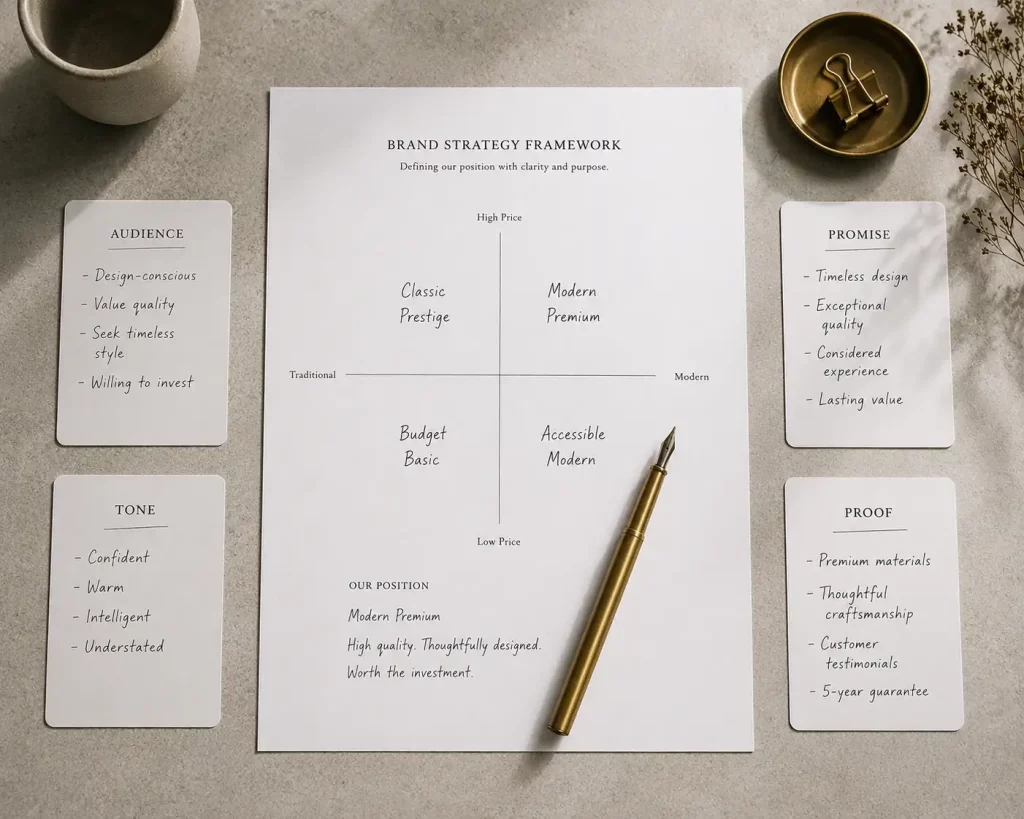
Brand strategy is the set of decisions that determine how your brand competes- decisions that, once made, shape everything else: your visual identity, your messaging, your tone, the experiences you create, and ultimately, how people choose you over an alternative.
At its core, brand strategy answers four questions. Who are you for, specifically, not generally? What do you offer that the alternatives don’t, in a way that’s credible and provable? How do you want to be perceived, and is that perception realistic given where you are today? And where are you headed — does this brand still make sense for the business you’re building toward, not just the one you have now?
A brand strategy agency’s job is to answer these questions through research and structured thinking, not assumption and to translate the answers into a framework that guides every creative and commercial decision that follows.

2. What a Brand Strategy Agency Actually Delivers
The output of a brand strategy engagement isn’t a mood board; it’s a set of decisions, usually documented and presented as a strategic framework. While the exact deliverables vary by agency, a genuine brand strategy process typically covers the following.
Market and competitor analysis
Not a generic SWOT exercise- a clear-eyed look at how competitors position themselves, where the gaps are, and where genuine differentiation is possible versus where every brand is making the same claim.
Audience definition
Moving beyond demographics into how your audience actually thinks and decides — what they currently use, what frustrates them about it, and what would make them choose differently.
Positioning statement
A single, clear articulation of where your brand sits in the market and why that position is both credible and ownable. This becomes the filter through which every future decision- visual, verbal, experiential- is tested.
Messaging framework
The core ideas your brand communicates, structured in a way that different teams that are marketing, sales, customer service- can draw from consistently, without sounding like they’re reading from a script.
Brand personality and tone of voice principles
How the brand should “feel” in communication, not as abstract adjectives, but as practical guidance: what this brand would say and what it would never say.
Crucially, none of this involves a logo. Strategy comes first precisely because it determines what the visual identity needs to express — not the other way around.
3. Signs Your Business Needs Brand Strategy Work
Brand strategy isn’t only for businesses starting from scratch. Some of the clearest signals come from established businesses that have outgrown the thinking their brand was originally built on.
If your team gives different answers when asked what makes the business different, that’s a strategy gap, not a communication training issue. If your marketing feels like it’s chasing trends rather than building on something consistent, the brand likely lacks a stable foundation to build from. If you’re entering a new market, launching a new product line, or have noticed competitors who started after you are now perceived as more premium, these are all moments where the existing strategy (or lack of one) is showing its limits.
And if you’re simply unsure whether your brand’s current positioning still reflects the business you’ve become, that uncertainty is usually the most reliable signal of all.
4. How to Tell Strategy Apart From Repackaged Design
Not every agency offering “brand strategy” is delivering strategic work. A useful test: ask what the process looks like before any design work begins. If the answer involves questionnaires about colour preferences and mood board reviews, that’s a design process with a strategic label attached.
A genuine strategy process involves research- conversations with your team, sometimes with your customers, analysis of competitors; and time spent understanding your business model and goals before any visual direction is discussed. It produces a document or framework you could hand to a new hire, a new agency, or an investor, and they would understand who your brand is for and why it matters- independent of any specific logo or website.


5. Why Brand Strategy Matters Differently in Dubai
Dubai’s market has a particular characteristic that makes brand strategy especially important: density. In almost every premium category that is hospitality, real estate, fashion, wellness, professional services- there are multiple well-funded, well-designed competitors operating in close proximity, often targeting the same audience.
In a market like this, good design is table stakes. Every serious competitor has a polished website and a clean visual identity. What separates the brands that build lasting recognition from those that blend into the category is strategy — a clear, defensible answer to why a customer should choose them specifically, communicated consistently across every interaction.
There’s also the matter of audience sophistication. Dubai’s premium buyers- HNIs, executives, discerning consumers, have been marketed to by some of the best brands in the world. Generic positioning doesn’t just fail to stand out here; it’s actively recognised as generic. Strategy is what allows a brand to say something that sounds considered, specific and true- rather than something that could belong to any competitor in the category.
Frequently Asked Questions
What’s the difference between brand strategy and brand identity?
Brand strategy is the thinking: who you’re for, what you stand for, how you’re positioned. Brand identity is the expression of that thinking- the logo, colours, typography and visual system. Identity built without strategy tends to look good but lack direction; strategy without identity has no way to be experienced. They work together, but strategy comes first.
How long does a brand strategy engagement take?
For most businesses, a focused brand strategy process takes between three and six weeks — covering research, stakeholder interviews, competitive analysis, and the development and refinement of the strategic framework. Larger organisations with more complex stakeholder groups or multiple business units may need longer.
Can I do brand strategy myself, internally?
You can start the conversation internally, and in fact, internal input is essential to any good strategy process. What’s harder to do internally is the outside perspective: an experienced strategist can see blind spots, untested assumptions, and category patterns that are difficult to spot from inside the business. Many businesses use internal workshops as a starting point and bring in external expertise to challenge, refine, and validate the thinking.
Do I need brand strategy if I’m rebranding rather than starting fresh?
Often even more so. A rebrand without revisiting strategy risks simply giving an outdated position a new look, solving the surface problem while leaving the underlying issue (the positioning no longer fits the business) untouched. Strategy work during a rebrand ensures the new identity is actually solving the right problem.
How do I measure whether brand strategy work has been effective?
The most reliable signals are qualitative before they’re quantitative: your team can explain what makes the business different, in similar terms, without prompting. Your marketing and content start to feel more focused and less reactive. Over time, this tends to translate into measurable outcomes- stronger conversion from brand-aware traffic, improved client quality, and greater pricing confidence, but these lag the strategic clarity itself.
What’s the cost of brand strategy in Dubai, and is it worth it as a standalone investment?
Standalone brand strategy engagements in Dubai typically range based on business complexity and depth of research required. It’s worth viewing as a standalone investment because it de-risks everything that follows a clear strategy makes design, messaging, and marketing decisions faster and more confident, which often reduces the total cost of those downstream projects.
Considering a Brand Strategy Engagement?
Pixtar works with premium brands, luxury businesses, and ambitious founders across Dubai and the UAE — building brand strategy frameworks that hold up under scrutiny and guide everything that follows.
Related reading:
What Brand Development Actually Means
Brand Strategy: What It Is and Why It Matters
Why Startups in the UAE Are Getting Branding Wrong
How to Build a Brand Identity
External references:
Interbrand — Brand Strategy Thinking
Harvard Business Review — Branding Insights