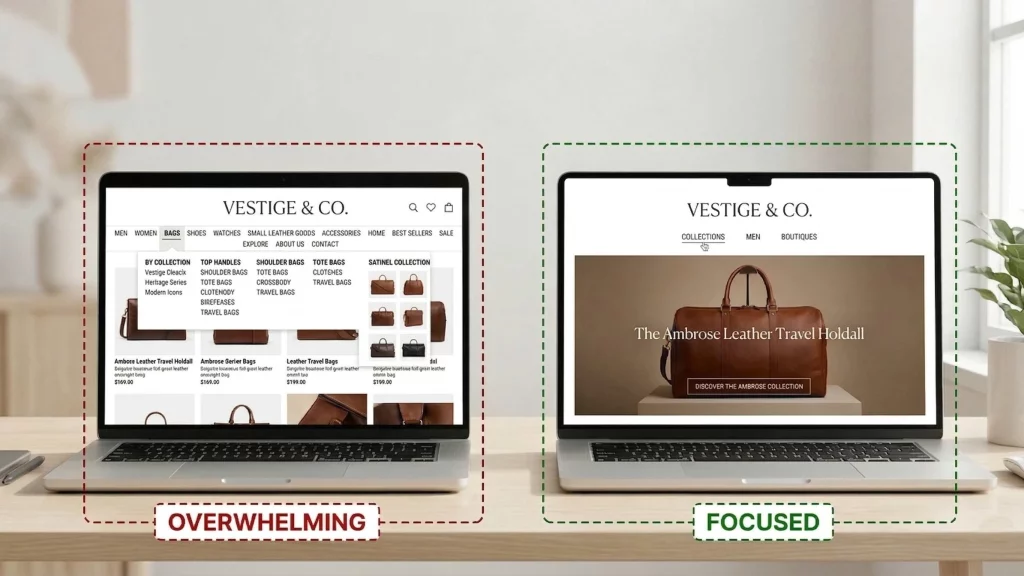
Quiet luxury has taken over fashion. The era of mega-menus with endless options is ending. At least for luxury brands that understand their audience. These brands are adopting minimalist website navigation. Fewer choices. Clearer paths. Interfaces that guide rather than overwhelm.
It turns out that simplicity doesn’t limit conversions. When done right, less navigation actually increases them.
Why Too Many Options Backfire
There’s psychological research behind this. It’s called choice paralysis. When faced with too many options, people struggle to decide. And when decisions feel difficult, people often don’t make them at all.
This applies directly to website navigation. A menu with 20 categories and subcategories might seem comprehensive. But to visitors, it feels overwhelming. Where do they start? What’s actually relevant to them? The cognitive load is high before they’ve even clicked anything.
Premium buyers especially dislike this. They expect curation. They expect brands to know what matters and show them exactly that. Not everything. Just what’s important.
Minimalist website navigation says: we know our brand, we know what you need, and we’ll get you there efficiently.
What Quiet Luxury Websites Look Like
Primary navigation is minimal. Three to five main categories maximum. Not fifteen. These aren’t lazy oversimplifications. They’re strategic decisions about what truly matters.
A luxury hotel website might have: Rooms, Dining, Experiences, Location, Book. That’s it. Everything else lives within those sections, accessed when relevant. The top-level navigation stays clean.
Secondary information is progressively disclosed. You don’t see everything at once. As you engage, more reveals itself. This creates a sense of discovery rather than bombardment. It respects attention and rewards exploration.
Navigation doesn’t compete for attention. In quiet luxury web design, navigation is present but subtle. It doesn’t shout. It doesn’t use bright colors or large type. It’s there when you need it and invisible when you don’t.
Some premium sites use navigation that appears on hover or scroll. Others use minimal text links rather than buttons. The goal is to guide without intruding.
Footer navigation does the heavy lifting. The footer becomes the place for comprehensive links. Policies, detailed information, additional resources. This keeps the main navigation focused while ensuring nothing important is inaccessible.
At Pixtar, when we design for premium brands, we cautiously edit navigation. Every link has to earn its place. If it doesn’t serve the primary user journey, it moves to secondary navigation or the footer.
How This Increases Conversions
Reduced cognitive load speeds decisions. When visitors face fewer choices, they move faster. They don’t get stuck analyzing options. They pick the obvious path and progress.
Clearer hierarchy improves understanding. When navigation is simple, people immediately understand your offerings. They grasp your structure without effort. This clarity builds confidence. Confident users convert more readily.
Focus increases relevance. When you show less, what you do show becomes more significant. A menu with three options makes each one feel important. A menu with twenty options makes all of them feel like background noise.
Premium perception strengthens. Minimalist website navigation signals confidence and refinement. It suggests you’re not trying to be everything to everyone. You know exactly who you are and what you offer. That confidence is attractive to premium buyers.
What to Remove
Look at your current navigation honestly. What can be consolidated or removed?
Combine similar categories. If you have separate menu items for “Our Story,” “Our Team,” and “Our Values,” combine them into one “About” section with clear subpages.
Remove vanity pages. Pages that exist because you think they should, not because users need them. If analytics show almost no one visits a section, consider whether it deserves top-level navigation.
Eliminate redundant paths. If users can reach the same destination three different ways from your main menu, you have too many options. Pick the clearest path and remove others.
Hide technical or legal links. Privacy policies, terms of service, and similar pages don’t need prime navigation real estate. Footer placement is appropriate.
When Simplicity Goes Too Far
There’s a balance. Minimalist website navigation shouldn’t become deliberately obtuse. Users shouldn’t have to hunt for basic information or guess where to find core features.
The goal is intuitive simplicity, not fashionable obscurity. Every removed navigation item should be replaced with a clearer path to that information, not just deleted because minimalism looks cool.
Test your navigation with real users. If they can’t find what they need quickly, you’ve oversimplified. The right balance feels effortless, not confusing.
Mobile Makes This Even More Critical
On mobile screens, navigation space is precious. You physically can’t display as many options. This constraint forces prioritization. And that forced prioritization often improves the desktop experience too.
When you design navigation for mobile first, you identify what truly matters. Those priorities then inform your desktop navigation. The result is clearer structure across all devices.
Examples in Action
Look at websites for Brunello Cucinelli, The Row, or Aesop. Their navigation is remarkably simple. Three to five main categories. Clean typography. No clutter. Yet you can find everything you need.
These brands aren’t hiding information. They’re presenting it hierarchically. They’re guiding you through experiences rather than dumping options on you.
That’s the essence of quiet luxury web design. It doesn’t announce itself. It doesn’t try to impress with complexity. It simply works, elegantly and efficiently.
At Pixtar, we help premium brands determine what deserves prominent navigation and what can live elsewhere. This process often feels uncomfortable at first. Clients worry about “hiding” content. But when they see improved user engagement and conversion metrics, the value becomes clear.
The Confident Approach
Minimalist website navigation is an act of confidence. It says: we don’t need to show you everything at once to prove our value. We trust you’ll discover what matters as you engage with us. We trust ourselves enough to prioritize.
Brands uncertain about their positioning tend to over-explain and over-navigate. They worry that if something isn’t immediately visible, users won’t find it. So they put everything in top-level navigation. The result feels anxious.
Quiet luxury does the opposite. It assumes you’re here for a reason. It guides you toward that reason efficiently. It doesn’t second-guess itself with redundant options and excessive links.
The Simple Truth
Less navigation doesn’t mean less information. It means better organization. It means respecting user attention. It means confidence in your brand structure.
For premium brands, minimalist website navigation aligns perfectly with market expectations. Your audience doesn’t want to be overwhelmed. They want to be guided. Give them clear paths, not endless options. Simplicity converts.