There is a conversation that happens in almost every client discovery call. A founder — often running a growing business in Dubai — says they want “branding”. When we dig deeper, what they actually mean is far bigger than a logo and a colour palette. They want people to understand what their company stands for. They want their team to feel proud of it. They want customers to choose them over a cheaper competitor without needing an explanation for why.
That is not branding. That is brand development. And the difference matters more than most people realise.
Table of Contents
1. Branding Is an Output. Brand Development Is a Process.
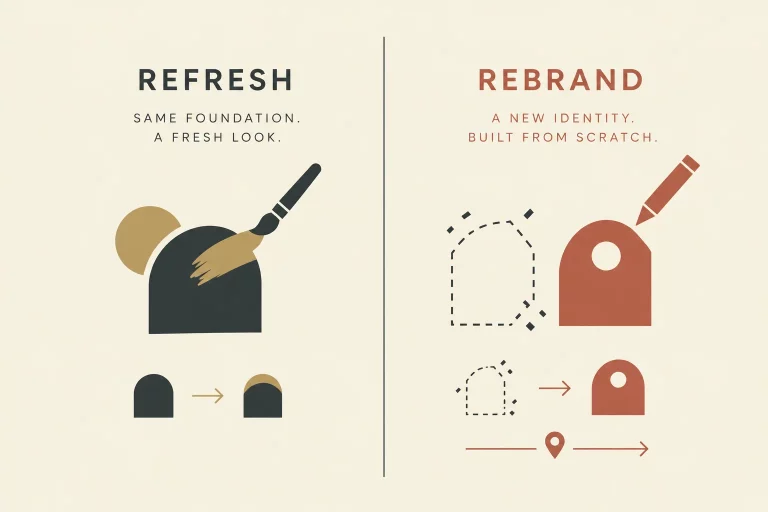
Branding refers to the tangible, visible expression of your brand — the logo, the typography, the colour system, the visual language. It is what gets designed and delivered.
Brand development is everything that happens before and around that. It is the strategic thinking that determines who you are, who you are for, how you speak, what you believe, and where you are headed. Branding without brand development is decoration. It looks good in a presentation and falls apart the moment someone asks a hard question — like what makes you different? — and no one in the room can give a consistent answer.
For businesses operating in Dubai’s competitive market, this distinction is not academic. The UAE has one of the highest densities of premium brands per capita in the world. Your audience — whether they are HNI clients, luxury buyers, or corporate decision-makers — encounters well-branded companies every day. They are not easily impressed by aesthetics alone. What actually earns their trust is coherence: a brand that knows exactly what it is, says it clearly, and delivers on it consistently.
Key Distinction: Branding is the visible output — the logo, colours, typography. Brand development is the strategic foundation that makes those outputs mean something. One without the other produces decoration, not direction.
2. What Brand Development Actually Covers
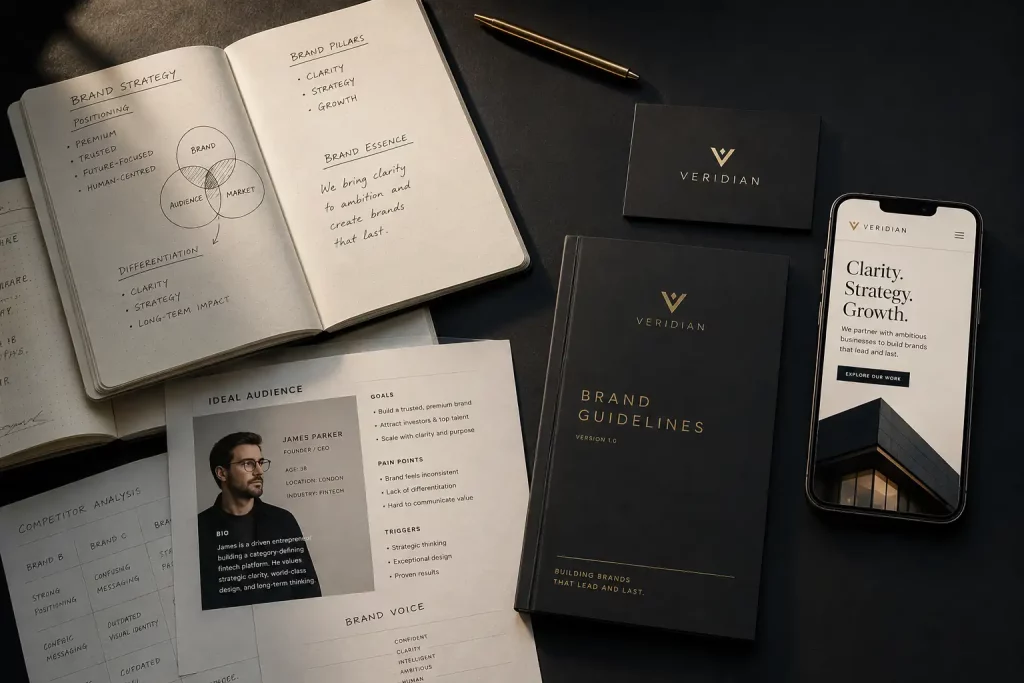
A proper brand development process works through several interconnected layers. Each one builds on the last — which is why skipping steps always creates problems downstream.
Brand Discovery and Research
Before anything is built, there is listening. Understanding the market landscape, identifying where genuine whitespace exists, and mapping out how your audience thinks and decides. This is research-led — not assumption-led. The output is not a document; it is clarity.
Brand Positioning
Where does your brand sit in the market? Not in the vague, aspirational sense, but specifically. What is the one thing you want to own in the mind of your ideal customer? Positioning shapes every decision that follows. Without it, you are making aesthetic choices in a vacuum.
Brand Architecture
For businesses with multiple products, services, or sub-brands, this is the work of deciding how everything relates to each other. A holding company in Dubai with four subsidiaries needs to know whether those entities should be connected, separate, or somewhere in between. The answer has significant consequences for design, marketing spend, and how customers perceive the group.
Naming and Messaging
What you are called and how you talk about yourself. Both need to feel intentional, both need to work across English and Arabic contexts in the UAE, and both need to hold up five years from now — not just next quarter. Messaging also gives your sales team, your content team, and your leadership a shared language. That consistency compounds over time.
Visual Identity
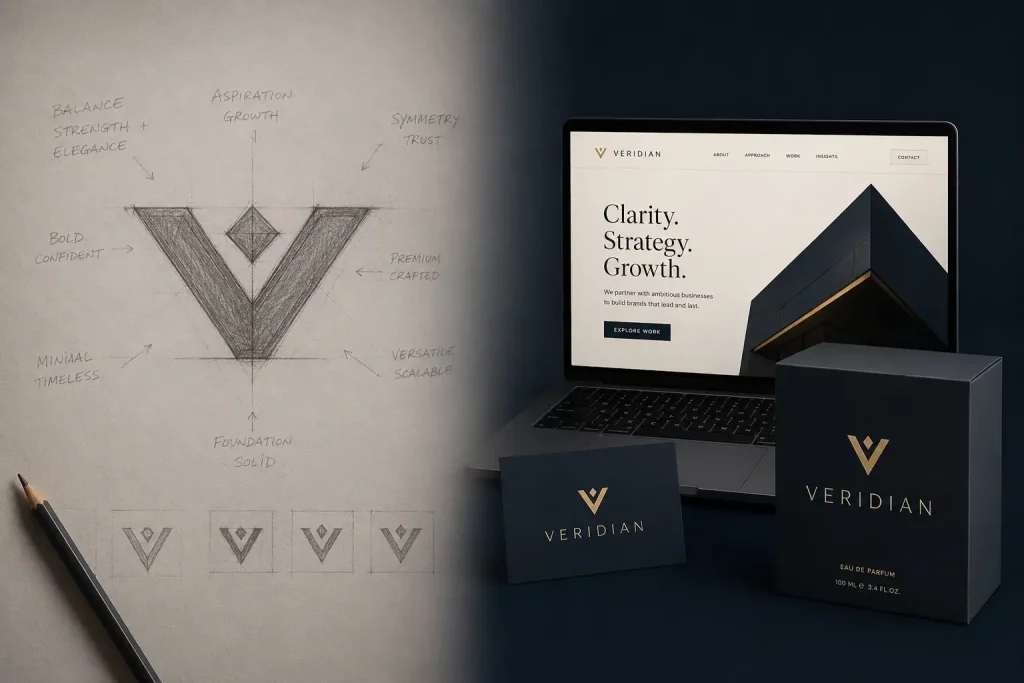
This is where branding — in the traditional sense — lives. The logo, the visual system, the design language. It arrives here, at this point in the process, because it is built on a foundation that actually means something. When visual identity emerges from positioning rather than aesthetic preference, it is more distinctive, more defensible, and more durable.
Brand Guidelines and Governance
A brand only works if it is applied consistently. Guidelines document the rules so that every touchpoint — whether it is a social post, a client proposal, or a shop fit-out — reinforces the same identity rather than diluting it. For growing businesses, this is how you scale without losing coherence.
3. Why This Matters More in Dubai Than Almost Anywhere Else
The UAE market has a few characteristics that make brand development — not just branding — genuinely essential.
The pace of business here is extraordinary. New competitors enter the market constantly. What looked like a clear positioning six months ago can feel crowded within a year. Brands that have only invested in aesthetics have nothing to fall back on when that happens. Brands that have done the deeper work have a foundation that holds.
The audience is also exceptionally discerning. Dubai attracts high-net-worth individuals, C-suite executives, and sophisticated buyers who have experienced the world’s best brands. They notice when something does not feel right — even if they cannot articulate exactly why. That unease costs you the sale.
And the ambition here is real. Most founders we speak to are not building for Dubai alone. They want to grow across the GCC, expand into Europe, attract international investment. A brand that was built only for today — without the strategic thinking to scale — becomes a liability the moment that growth happens.
On GCC Expansion: Brand development includes decisions about naming conventions, Arabic and English language considerations, and cultural resonance across different markets. Without this layer, a brand that works in Dubai can feel misaligned or generic in Saudi Arabia, Bahrain, or Kuwait.

4. How to Know Which One You Actually Need
The answer depends on where you are and where you are heading.
If you are about to launch and need a visual identity, you need both — but brand development has to come first. Building a visual identity without positioning is like designing the façade of a building before deciding what it will be used for.
If you have an existing brand and something feels off — sales are inconsistent, clients are confused about what you offer, your team cannot agree on how to describe the company — you almost certainly have a brand development problem, not a design problem. A new logo will not solve it.
If you are expanding into a new market or launching a new product line, brand development is how you decide whether to extend your existing identity or build something distinct. That decision has real financial implications for how you market, how you staff, and how you price.
If you are preparing for investment or acquisition, brand development is what gives your business a coherent, defensible story — one that holds up to scrutiny. Investors are not buying your logo. They are buying your positioning, your audience relationship, and the strategic clarity behind both.
| Situation | What You Need |
|---|---|
| Launching a new business | Brand development first, then visual identity |
| Existing brand feeling inconsistent or unclear | Brand development — the problem is strategic, not visual |
| Expanding into GCC or international markets | Brand development — positioning and naming review for each market |
| Preparing for investment or acquisition | Brand development — to build a coherent, defensible story |
| Launching a new product or sub-brand | Brand architecture review + brand development for the new entity |
5. The Real Cost of Skipping It
A rebrand costs more than an initial brand build. A repositioning exercise costs more than getting the positioning right the first time. And the damage done by years of inconsistent, misaligned brand communication — lost clients, confused prospects, missed premium pricing — is difficult to quantify but very real.
The businesses that resist brand development investment typically do so because they cannot see an immediate return. The problem is that a weak brand compounds its costs quietly. Every marketing campaign built on unclear positioning underperforms. Every sales conversation that starts with “so, what exactly do you do?” is a symptom. Every competitor who charges more for an objectively similar service — and wins — is capturing value that a stronger brand would have held.
Brand development is not a luxury. It is the foundation on which everything else is built. Invest in it properly once, and you build something that works. Shortcut it, and you will be revisiting it sooner than you planned — at considerably greater cost.
Frequently Asked Questions
What is the difference between brand development and branding?
Branding refers to the visual and verbal outputs of a brand — the logo, colours, typography, and tone of voice. Brand development is the strategic process that creates the foundation for those outputs: the positioning, the audience definition, the messaging, the architecture. You cannot build a strong brand without first doing the development work.
How long does brand development take?
A thorough brand development process for a small-to-mid-size business typically takes between four and twelve weeks, depending on the scope. For larger organisations or those with complex brand architecture needs, it can take longer. Rushed brand development tends to produce positioning that sounds good in a presentation but does not hold up in the real world.
Do I need brand development if I already have a logo?
Having a logo is not the same as having a developed brand. If your business is growing but your communications feel inconsistent, your team struggles to explain what makes you different, or your visual identity no longer reflects where you are headed — these are signs that brand development work is overdue. Design cannot solve a strategic problem.
How much does brand development cost in Dubai?
The investment varies significantly depending on the depth of the engagement, the size of the business, and the scope of deliverables. A foundational brand development process in Dubai typically ranges from AED 15,000 to AED 80,000 and above for enterprise-level work. The more relevant question is what it costs not to invest in it — in lost positioning, inconsistent client experiences, and eventual rebranding. For a transparent view of what branding and brand development cost in Dubai, read our branding cost guide.
Can brand development help with expansion across the GCC?
Yes — and it is particularly important for UAE businesses planning to scale regionally. Brand development includes decisions about naming conventions, visual adaptability, Arabic and English language considerations, and cultural resonance across different markets. Without this strategic layer, a brand that works in Dubai can feel misaligned or generic in Saudi Arabia, Bahrain, or Kuwait.
What is brand architecture and do I need one?
Brand architecture defines how the different parts of your business — parent company, subsidiaries, product lines, services — relate to each other visually and verbally. Not every business needs a complex architecture, but any organisation with more than one offering or entity benefits from having clear rules about how those pieces connect. Without it, you risk building brand equity in five different directions rather than one.
How does brand development affect SEO and digital performance?
A well-developed brand produces clearer messaging, more consistent content, and stronger topical authority — all of which support organic search performance. When your brand has a defined voice and positioning, your content naturally clusters around the same themes, signals expertise to search engines, and builds the kind of trust that turns organic visitors into enquiries.
Explore related thinking:
→ Why Every Business Needs a Website — and how your digital presence reflects your brand clarity
→ Brand Strategy: What It Is and Why It Matters
→ How to Build a Brand Identity
→ How Branding Services in Dubai Can Help Your Business
Ready to Build a Brand That Actually Works?
Brand development is not the expensive option — it is the one that pays for itself. If your brand is not clearly positioned, consistently communicated, and built to scale, let us fix that.